“Replace ‘Ruling’ and ‘Opposition’ Parties terminology with ‘Serving’ and ‘Supporting’ for the betterment of country”
 admin
0 comments
admin
0 comments
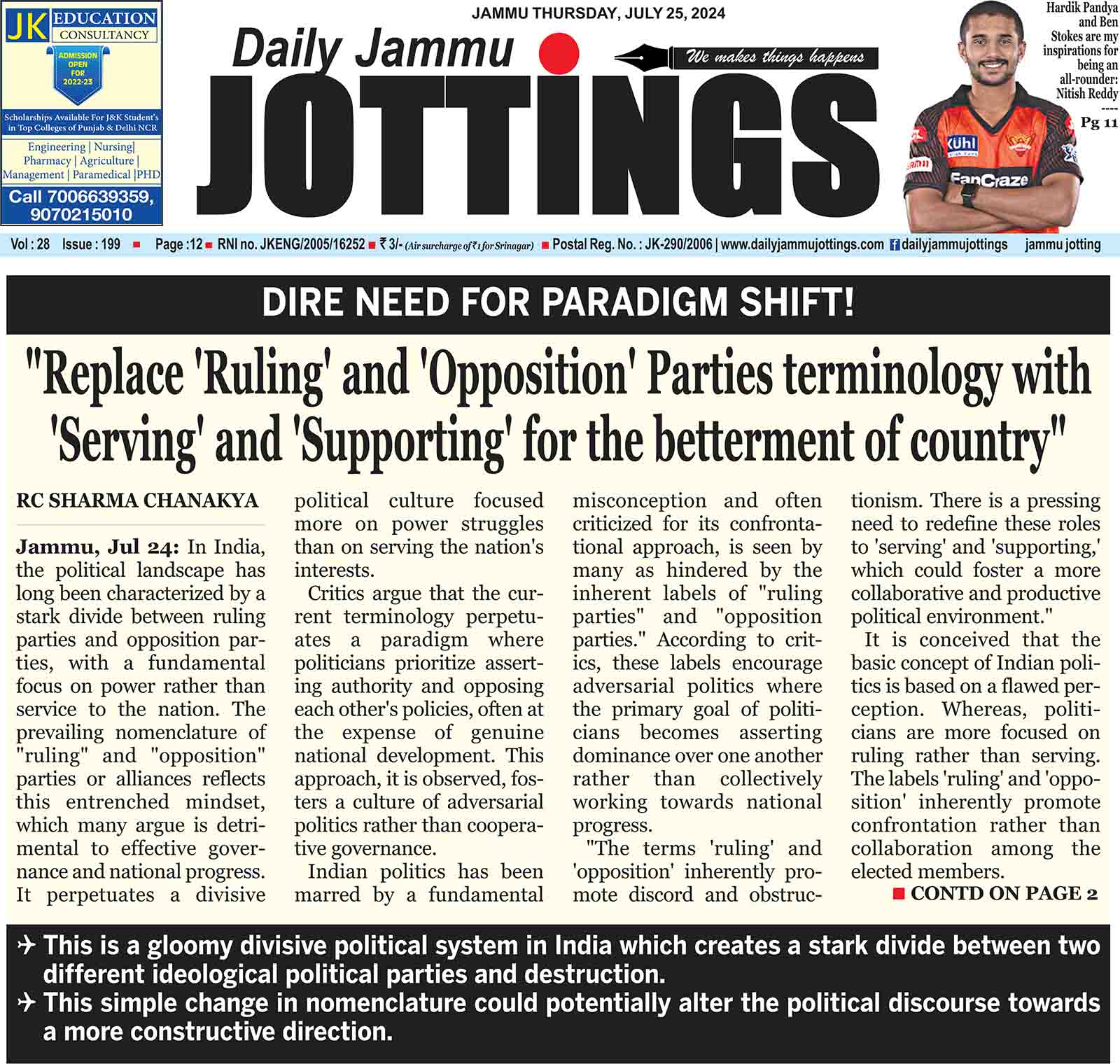
Dire need for paradigm shift!
- This is a gloomy divisive political system in India which creates a stark divide between two different ideological political parties and destruction.
- This simple change in nomenclature could potentially alter the political discourse towards a more constructive direction.
RC Sharma Chanakya
Jammu, Jul 24: In India, the political landscape has long been characterized by a stark divide between ruling parties and opposition parties, with a fundamental focus on power rather than service to the nation. The prevailing nomenclature of “ruling” and “opposition” parties or alliances reflects this entrenched mindset, which many argue is detrimental to effective governance and national progress. It perpetuates a divisive political culture focused more on power struggles than on serving the nation’s interests.
Critics argue that the current terminology perpetuates a paradigm where politicians prioritize asserting authority and opposing each other’s policies, often at the expense of genuine national development. This approach, it is observed, fosters a culture of adversarial politics rather than cooperative governance.
Indian politics has been marred by a fundamental misconception and often criticized for its confrontational approach, is seen by many as hindered by the inherent labels of “ruling parties” and “opposition parties.” According to critics, these labels encourage adversarial politics where the primary goal of politicians becomes asserting dominance over one another rather than collectively working towards national progress.
“The terms ‘ruling’ and ‘opposition’ inherently promote discord and obstructionism. There is a pressing need to redefine these roles to ‘serving’ and ‘supporting,’ which could foster a more collaborative and productive political environment.”
It is conceived that the basic concept of Indian politics is based on a flawed perception. Whereas, politicians are more focused on ruling rather than serving. The labels ‘ruling’ and ‘opposition’ inherently promote confrontation rather than collaboration among the elected members.
The Indian Parliament, as the apex legislative body, is often at the center of this dichotomy. Debates and discussions frequently devolve into partisan clashes, where the primary objective appears to be scoring political points rather than finding common ground for the greater good.
The need of the hour is that there should be a significant shift in mindset, which can ensure for deliverance of good governance. “Instead of ‘ruling’ and ‘opposing,’ why not adopt terms like ‘serving’ and ‘supporting’? This simple change in nomenclature could potentially alter the political discourse towards a more constructive direction.”
The proposal suggests that renaming parties or alliances to emphasize “serving” and “supporting” could encourage a paradigm shift towards governance that prioritizes the welfare of the people. Proponents argue that such a change could incentivize political leaders to focus on constructive debate and consensus-building rather than mere opposition for the sake of it.
Advocates for reform argue that renaming the parties or alliances as “serving” and “supporting” would encourage a focus on collective welfare and consensus-building. It could foster an environment where political leaders are incentivized to collaborate on policies that benefit the populace, rather than simply blocking initiatives based on partisan interests.
However, implementing such a constitutional amendment would require broad political consensus and legislative action. It would necessitate bipartisan support and a collective will among lawmakers to prioritize national interest over partisan agendas.
The current system often leads to policy paralysis, is has been substantiated in several parliament session in past. If we redefine the roles to emphasize service and support, it could encourage politicians to prioritize governance over political maneuvering.
Calls for such a change in terminology have gained traction in recent years, especially among civil society groups and progressive lawmakers. They believe that redefining the roles could align India’s political discourse more closely with the aspirations of its citizens.
However, implementing such a paradigm shift would require broad consensus and legislative action within the Indian Parliament. It would necessitate a willingness among political leaders to transcend traditional divides and prioritize national interest above party politics.
As the debate continues, the question remains whether India’s political leadership will embrace a new narrative that emphasizes service and collaboration, thereby potentially transforming the country’s political landscape for the better.
For now, the discussion around redefining the nomenclature of political parties and alliances serves as a critical reflection on India’s democratic ethos and its evolution in the 21st century.
In conclusion, while the proposal for renaming political parties is still in its nascent stages, it has sparked a crucial debate about the future of Indian democracy and the role of political entities in serving the nation’s interests. Whether this proposal gains traction and materializes into legislative action remains to be seen, but its proponents remain steadfast in their belief that such a change could be a catalyst for positive change in India’s political arena.