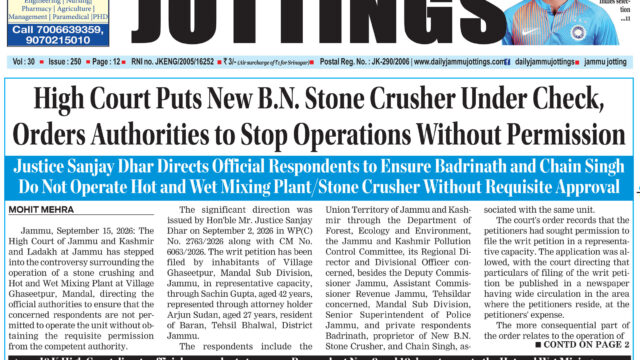
Rs 10 Per Plot for Digital Crop Survey Sparks Concern; Field Workers Deserves Fair Pay and Safety Cover
 admin
admin 
The Government must increase the remuneration from Rs 10 to Rs 50 per plot to ensure justice for those working in the field to collect accurate agricultural data.
RC Sharma Chanakya
JAMMU: The Government’s ambitious Digital Crop Survey (DCS) initiative, aimed at creating an accurate and real-time database of crops cultivated on agricultural land, has raised serious concerns among the field-level workers engaged to execute the exercise, particularly those associated with Common Service Centres (CSCs), Kisan Khidmat Ghars (KKGs), Farmer Producer Organisations (FPOs) and other support institutions.
The Government must consider urgently to raise the remuneration from Rs 10 to at least Rs 50 per plot to ensure justice, dignity and fair compensation for the field workers undertaking the arduous task of collecting accurate agricultural data. Their dedication and ground-level efforts deserve meaningful financial recognition.
The Digital Crop Survey is designed to generate plot-level agricultural data through mobile applications, geo-referenced maps and satellite-based technologies, thereby strengthening the agricultural information system and facilitating more targeted delivery of government schemes and benefits. However, the people undertaking the painstaking fieldwork on the ground say the compensation being offered to them is grossly inadequate in view of the nature and risks involved in the assignment.
According to reports, workers engaged on a non-salaried basis are being paid only Rs 10 per agricultural plot, irrespective of the size, location or accessibility of the plot. Unlike regular government employees, these field workers do not receive a monthly salary or fixed honorarium from the Government or any concerned department. Nevertheless, they are being relied upon to carry out an important government exercise that requires extensive movement through rural and agricultural areas.
The meagre payment becomes particularly concerning when the actual cost of conducting the survey is taken into account. A field worker can generally cover around 18 to 20 plots in an entire day, which translates into a maximum earning of only about Rs 200 daily. From this amount, the worker has to bear the cost of travelling, often using a personal two-wheeler, besides meeting expenses for fuel, refreshments and other field requirements.
The situation becomes even more challenging during the ongoing agricultural season, when workers have to physically enter fields and traverse remote and uneven terrain. With incidents of snake encounters and snake bites posing a genuine risk in agricultural areas, the absence of adequate safety provisions and insurance cover has emerged as a serious issue.
The workers associated with CSCs, KKGs, FPOs and similar institutions deserve particular consideration because they are effectively serving as the grassroots workforce for the implementation of the Government’s digital agricultural initiatives without enjoying the financial security available to regular government employees.
There is therefore a growing concern that the Government immediately review the existing remuneration structure and enhance the payment from Rs 10 to at least Rs 50 per agricultural plot. Such a revision would provide a more realistic compensation for the time, mobility, operational expenses and risks involved in the field survey.
The Government should also introduce a comprehensive safety and insurance mechanism for these workers. In the event of a snake bite, road accident or any other mishap occurring while performing officially assigned Digital Crop Survey duties, adequate medical assistance, insurance protection and compensation should be ensured.
The Digital Crop Survey is undoubtedly an important technological initiative capable of transforming agricultural data management and improving the delivery of benefits to farmers. However, the success of such a large-scale exercise ultimately depends upon the people working at the grassroots level.
While the Government has taken steps to ensure that farmers without smartphones or adequate digital access are not excluded from the Agristack ecosystem, with support being extended through FPOs, Krishi Sakhis and CSCs, equal attention must also be given to those who are actually taking these digital initiatives to the fields.
A technologically advanced agricultural system cannot be built by overlooking the welfare of its field workforce. The Government must therefore ensure fair remuneration, safety protection and insurance coverage for the workers engaged in the Digital Crop Survey, so that they can perform this crucial national assignment with dignity, security and confidence.