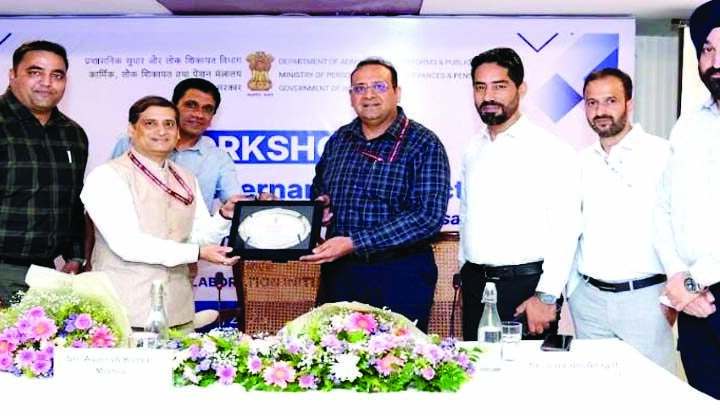
Rs 15 cr project to promote millet cultivation in J&K: ACS Atal Dulloo
 admin
0 comments
admin
0 comments

jj correspondent
Jammu, Feb 27: The Jammu and Kashmir Government on Monday approved a project to promote millets and increase their production and consumption in the Union Territory, said Atal Dulloo, Financial Commissioner, (Additional Chief Secretary), Agricultural Production Department.
“The project, which has an outlay of Rs 15 crores and will be implemented over three years, aims to promote the cultivation of millets, increase their value addition, and generate entrepreneurship opportunities for farmers” Dulloo explained.
He added, “the initiative also seeks to generate awareness regarding the nutritional value of millets, which are rich in proteins, micronutrients and phytochemicals.”
“Millets are known as the “miracle grains” or “crops of the future” due to their resilience to climate change. They can grow in drought-prone areas and do not require large amounts of water or external inputs, making them an ideal crop for small-scale farmers in Jammu and Kashmir,” said Dulloo adding millets are also a dual-purpose crop, providing both food and fodder, and contribute to the economic efficiency of farming.
“In recent years, there has been a renewed interest in millets due to their numerous health benefits and the need to find sustainable solutions to food security challenges,” Dulloo said adding that the Governments and organizations worldwide have started promoting millets as a nutritious, sustainable, and affordable food option.
Notably, the Government of India is actively promoting the cultivation, processing, and marketing of millets and in the past declared 2018 as the National Year of Millets. The United Nations General Assembly too, at the behest of the Government of India, has declared 2023 as the International Year of Millets to raise awareness about the health benefits and sustainable production and consumption of millets.
“Despite the growing awareness and popularity of millets, their production and consumption are still limited, and there are several challenges that need to be addressed. One of the significant challenges is the lack of awareness and knowledge about millets among farmers and consumers”, said Dulloo.
“Many farmers are still unaware of the benefits of millet cultivation and continue to struggle to cultivate high-input crops, resulting in the depletion of soil fertility and water resources, these are the issues that this ambitious initiative seeks to address”, he added.
“Promotion of Nutri-Cereals (Millets) in UT of Jammu& Kashmir is one among the 29 projects, which were approved by the Jammu and Kashmir administration after being recommended by the UT Level Apex Committee for holistic development of Agriculture and Allied Sectors in UT of J&K,” said the ACS.
The prestigious committee is headed by Dr Mangala Rai, Former DG ICAR and has other luminaries in the field of Agriculture, Planning, Statistics and Administration like Ashok Dalwai, CEO NRAA, Dr. P. K Joshi, Secretary, NAAS, Dr. Prabhat Kumar, Horticulture Commissioner MOA & FW, Dr. H. S Gupta, Former Director, IARI, Atal Dulloo, Financial Commissioner (Addl Chief Secretary) APD apart from the Vice Chancellors of the twin Agriculture Universities of the UT.
“Millets were once cultivated throughout Jammu and Kashmir in plains as well as in hilly areas. The major millets grown were buckwheat species, amaranth, and minor millets,” he said.
However, these crops were abandoned five or six decades ago throughout J&K, except in a few far-flung hilly areas of the UT, said Dulloo.
The initiative aims to revive millet cultivation in the region, which has been in decline for decades, he added and said adding, “The initiative hopes to expand the area under millet cultivation from 8310 ha to 14310 ha and distribute 550 quintals of high yielding variety (HYV) seeds.”
The project aims to revive over 8000 ha of traditional millet-growing areas with better packages of practices, add an additional 6000 ha under millet cultivation, and double per-hectare productivity from 10 to 20 quintals, he said, adding, “Additionally, 60 millet processing units and 60 millet restaurants serving millet-based food products will be established creating 6500 jobs and 120 enterprises in the whole process. Capacity building will be another key focus, with the aim of training 6000 farmers to increase productivity and profitability.”
The project’s success has the potential to bring numerous benefits to the region, such as diversifying crops in drought-prone areas, contributing to crop resilience and nutritional security for rural communities, he added and said, “Moreover, by strengthening the agro-processing of millets in the region, new economic opportunities will be created, providing additional income for farmers.”
“With millets being rich in micronutrients and phytochemicals, there is also the potential for millet-based food products to be developed and branded as smart food, contributing to the growing demand for healthy cereal-based foods in urban areas,” said the ACS.
In conclusion, the project to promote millets in Jammu and Kashmir is an important initiative that can address some of the challenges faced by farmers in the region while providing numerous benefits to the region’s economy, nutrition, and sustainability, he said.
“By prioritizing the promotion of resilient crops like millets, the project can contribute to creating sustainable and thriving agricultural communities that will be better equipped to face the challenges of a changing climate,” he asserted. UNI