Budget Session 2025! CM announces major step toward regularization of ‘Daily Wagers’, sets 6-month deadline for final framework
 admin
0 comments
admin
0 comments
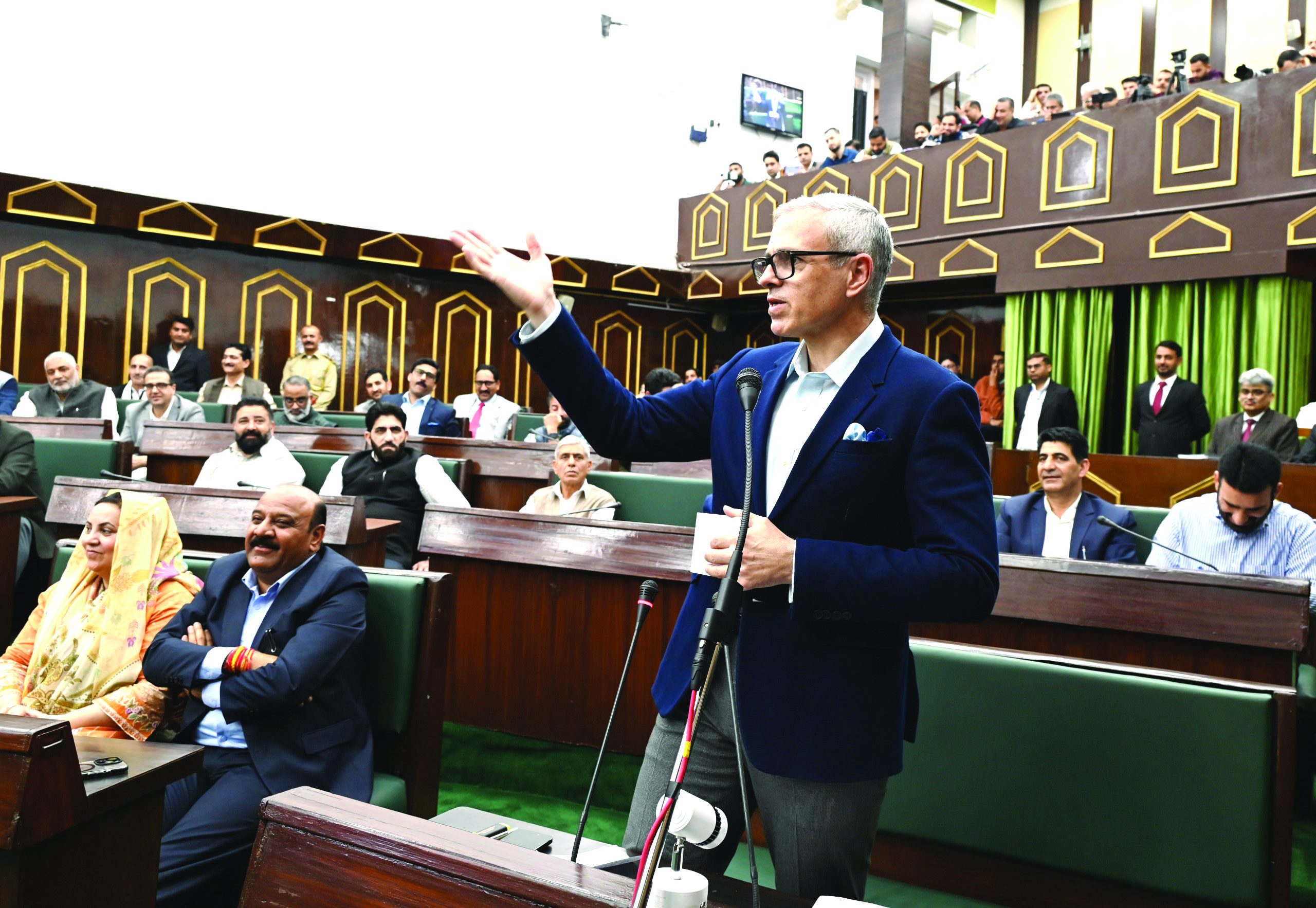
“This is a matter of human dignity, not just financial responsibility,” says CM Omar Abdullah.
“Budget 2025 lays the groundwork for Jammu and Kashmir’s path to self-reliance,” declares CM.
RC Sharma Chanakya
JAMMU, MAR 11: In a landmark development during the ongoing Budget Session of 2025, Chief Minister Omar Abdullah today revealed the formation of a high-level committee dedicated to addressing the long-standing issue of daily-rated workers in Jammu and Kashmir. The committee, to be chaired by Chief Secretary Atal Dulloo, is tasked with devising a detailed framework for regularizing daily wagers in the region. This ambitious initiative aims to bring justice to thousands of workers who have long been excluded from the formal employment system.
The Chief Minister outlined the steps the committee will take, including identifying the exact number of daily wagers, conducting both legal and financial assessments, and establishing a clear policy framework for their regularization. He set an ambitious six-month timeline for the completion of the report, with the policy to be discussed and finalized in the next budgetary session.
A humanitarian challenge, not just a financial Issue: In his address, CM Omar Abdullah emphasized that the issue of daily wagers is not merely a financial one, but rather a profound humanitarian and social issue. Reflecting on the recent incidents in Srinagar and Jammu, where daily wagers were met with police force during protests, the Chief Minister remarked, “What happened yesterday was a tragedy, one that we should not allow to happen again. But we must ask ourselves-how did we reach this point?”
The Chief Minister also took the opportunity to remind the House of his government’s earlier attempts to regularize daily wagers during his previous tenure, which were ultimately disrupted by the devastating 2014 floods and the electoral cycle. He called out the opposition, asking, “What did you do to address the issue when you were in power? I reviewed your budget speeches, and the only mention of daily wagers was vague, with no concrete plans for their regularization. Even after SRO-520 was issued, only a meager 577 daily wagers were regularized.”
The challenges ahead; a call for action: In his address, CM Abdullah made it clear that despite having both state and central authority in the past, previous governments had failed to address the issue of daily wagers. He accused the opposition of prioritizing other matters, like the implementation of the 7th Pay Commission, while the plight of daily-rated workers was left unresolved.
“The J&K Reorganization Act effectively closed the doors to the regularization of daily wagers,” the Chief Minister explained. “Now, it is our responsibility to reopen that door. But the challenge is that the number of daily wagers has fluctuated over the years,
making it difficult to accurately assess the scale of the problem.”
He stressed the need for a fresh approach, emphasizing that this issue must be tackled from the ground up, with the government taking proactive steps to resolve the concerns of these workers.
Budget 2025; a realistic path forward, not pessimism: In response to criticism of his budget speech, which some labeled as “pessimistic,” the Chief Minister set the record straight, explaining that his words were not meant to be negative but were grounded in realism. “Some have criticized my opening remarks as pessimistic. Let me clarify, they were not pessimistic; they were realistic. I spoke of the challenges we face because that is the truth. It would have been pessimistic to claim that we are doomed, but instead, I said that we are dealing with significant wounds and do not have the resources to heal them instantly.”
He added, “We are facing fiscal constraints in this Union Territory. Do we have the funds to take full control of power projects or to provide free electricity to everyone? No. The reality is, we are still purchasing electricity from outside, and our budget is not sufficient to guarantee 24-hour electricity supply.”
Fiscal responsibility; a vision for long-term growth: Drawing attention to the fiscal constraints, CM Omar Abdullah quoted the well-known proverb, “Cut your coat according to your cloth,” underscoring the importance of managing within available resources. He acknowledged that the budget would not yield immediate results but emphasized that it laid the groundwork for future growth.
“This budget serves as a solid foundation,” he explained. “While we may not see immediate results, we have set in motion the processes that will transform Jammu and Kashmir into a stronger, more prosperous region over the next five years.”
Opposition criticism; deflecting from the real issues: The Chief Minister also responded to the opposition’s criticism, particularly members of the Bharatiya Janata Party (BJP), who had veered off-topic during their speeches by raising issues like Article 370, Maharaja Ji, and the events of July 13. “I initially thought their speeches would focus on the budget, but instead, they continued to discuss issues that are irrelevant to the immediate needs of the people,” the Chief Minister remarked. “The people of Jammu and Kashmir want answers about jobs, welfare, and economic progress, not outdated debates.”
A ‘Love Letter’ to the people of Jammu and Kashmir: In a heartfelt statement, CM Omar Abdullah described his budget speech as a “love letter” to the people of Jammu and Kashmir. “Why do we write love letters? To express our affection and commitment. And when we speak of love, we must consider those who are in need. This budget is our attempt to show that love, by addressing the concerns and aspirations of the people,” he said.
He reiterated that his government’s vision for the future would involve continuous engagement with the people. “I am not ashamed to call it a love letter. In fact, we will continue to write these love letters in the coming years-letters filled with the promise of progress, commitment, and transformation for the people of Jammu and Kashmir.”
Acknowledging the central government’s support: Responding to criticism about his acknowledgment of the central government’s financial support, CM Omar Abdullah candidly stated, “Why should I be ashamed to admit that the central government has helped us? The reality is that we are not yet self-sufficient, but we are working hard toward that goal. It is not about denying our challenges but about striving for a future where Jammu and Kashmir stands on its own.”
He emphasized that the goal of his government was not to remain dependent on central funds but to foster a self-reliant Jammu and Kashmir. “We aspire for more. Our aim is to build a future where we stand tall and independent, both economically and socially.”
Centrally sponsored schemes; a clarification: The Chief Minister also addressed misconceptions regarding Centrally Sponsored Schemes (CSS), explaining that while these schemes are often seen as solely funded by the Government of India, the Jammu and Kashmir government also contributes significantly to their implementation. He cited the example of the PM Golden Card and the National Social Assistance Program, pointing out that the UT government covers a substantial portion of the benefits for families that do not fall under central schemes.
A new era for Jammu and Kashmir’s budget: For the first time in history, the budget of Jammu and Kashmir is being discussed within the region itself, as opposed to merely being passed in Parliament. CM Omar Abdullah hailed this as a major achievement, remarking, “This is a significant step forward. Some may argue that we still lack a government of our own, but this budget is for the people of Jammu and Kashmir, and it is being debated where it truly belongs.”
Restoring dignity and empowerment; a vision for the future: The Chief Minister concluded his speech by reaffirming his government’s commitment to restoring the dignity, empowerment, and self-reliance of the people of Jammu and Kashmir. “Some may view our initiatives as small steps, but remember, even the largest oceans are formed from countless drops. With these steps, we are laying the foundation for a self-sufficient, prosperous future. InshaAllah, in five years, we will restore the dignity of our people and transform Jammu and Kashmir into a self-reliant region.”
Earlier discussions; a collaborative approach: Earlier in the session, various Members of the Legislative Assembly, including Qayser Jamsheed Lone, Showkat Hussain Ganie, Javed Iqbal Choudhary, Shagun Parihar, Abdul Majeed Larmi, Rafiq Ahmad Naik, Shabir Ahmad Kullay, Sajad Lone, Zafar Ali Khatana, Baldev Raj Sharma, and Saif Ud Din Bhat, contributed to the discussion on budgetary provisions, offering their views and suggestions for further improving the fiscal framework.
With this budget, CM Omar Abdullah has reinforced his commitment to a prosperous and self-reliant Jammu and Kashmir-one that not only survives but thrives in the coming years.