A legacy of neglect & decline, failure of leadership, missed opportunities, fall of a political stronghold
 admin
admin 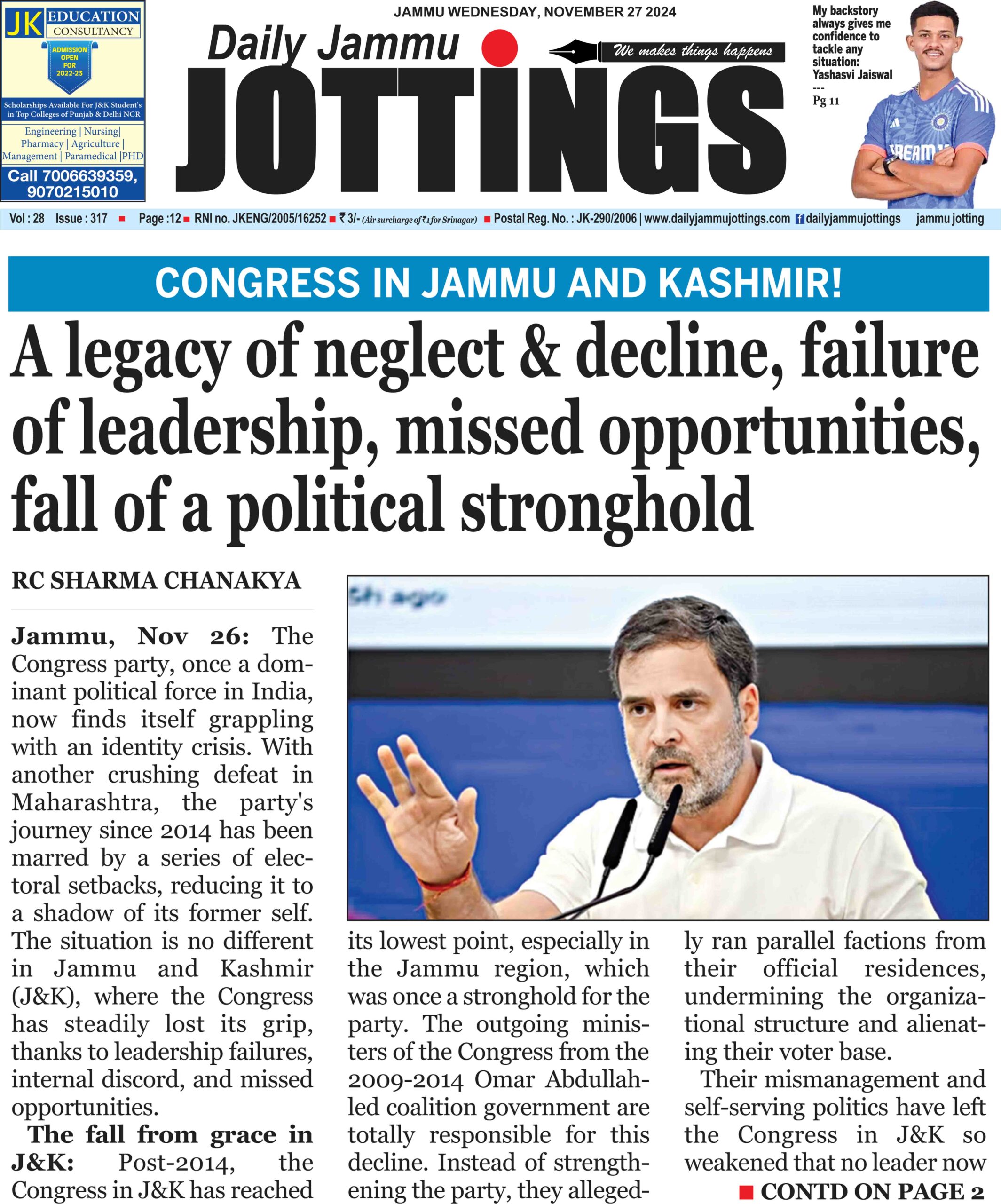
Congress in Jammu and Kashmir!
RC Sharma Chanakya
Jammu, Nov 26: The Congress party, once a dominant political force in India, now finds itself grappling with an identity crisis. With another crushing defeat in Maharashtra, the party’s journey since 2014 has been marred by a series of electoral setbacks, reducing it to a shadow of its former self. The situation is no different in Jammu and Kashmir (J&K), where the Congress has steadily lost its grip, thanks to leadership failures, internal discord, and missed opportunities.
The fall from grace in J&K: Post-2014, the Congress in J&K has reached its lowest point, especially in the Jammu region, which was once a stronghold for the party. The outgoing ministers of the Congress from the 2009-2014 Omar Abdullah-led coalition government are totally responsible for this decline. Instead of strengthening the party, they allegedly ran parallel factions from their official residences, undermining the organizational structure and alienating their voter base.
Their mismanagement and self-serving politics have left the Congress in J&K so weakened that no leader now appears capable of winning elections in the region.
From January 2009 to December 2014, the Congress was a key partner in the coalition government led by Omar Abdullah of the National Conference (NC). However, the Congress ministers in this government are widely seen as the architects of the party’s downfall in J&K, particularly in the Jammu region.
A pivotal moment in this decline was the loss of senior Congress leader and former Deputy Chief Minister, Pt. Mangat Ram Sharma, in the Jammu West assembly constituency during the Bum Bum Bhole agitation. Sharma, considered the “soul” of the Congress in the region, was a formidable leader whose defeat was a significant blow to the party. The Congress has since struggled to recover from this loss.
Missed opportunity: The exclusion of Pt. Mangat Ram Sharma: After the untimely demise of MLC Yashpal Khajuria, a golden opportunity emerged for the Congress to nominate Pt. Mangat Ram Sharma to the Legislative Council. His name was almost finalized, and his entry could have rejuvenated the party’s leadership. However, internal politics and the ambitions of certain ministers and national leaders prevented his nomination.
Fearing that Sharma’s entry into the Council would result in his elevation to a top ministry in the Omar Abdullah government, vested interests within the party sabotaged his nomination. Despite efforts by then PCC president Prof. Saif-ud-Din Soz to ensure Sharma’s inclusion, these internal factions succeeded in sidelining him, resulting in a significant leadership void.
The aftermath of neglect: The sidelining of Pt. Mangat Ram Sharma marked the beginning of a deeper crisis for the Congress in J&K. The leadership vacuum and infighting left the party rudderless. One Congress minister from the Omar-led coalition government went on to lose four consecutive elections, highlighting the devastating impact of poor leadership and internal sabotage.
Today, those who once held ministerial positions during the coalition government are politically irrelevant, having lost their base and credibility among voters. The once-strong Congress party in J&K is now a shadow of its former self, struggling to even maintain a foothold in the region.
A path to revival: The Congress must reflect on these past mistakes and take decisive action to rebuild its structure in J&K. Reviving grassroots support, fostering unity within the party, and empowering credible leaders are critical steps to reclaiming lost ground. The failure to do so could further cement its legacy as a party of missed opportunities and internal discord.
The story of the Congress in J&K serves as a stark reminder: without cohesive leadership and a focus on the collective good, even the strongest of political legacies can crumble. For the Congress, the time to act is now, or it risks being relegated to irrelevance in the political landscape of Jammu and Kashmir.