

Four ministers sworn in as Farooq Abdullah calls reshuffle a “good change”; Gul’s supporters protest, Larmi expresses heartbreak and Omar faces mounting pressure to contain internal dissent
- The Council of Ministers has reached its maximum permitted strength of nine, leaving no immediate Cabinet space for overlooked legislators.
- Farooq Abdullah says the new ministers will work to ease public difficulties, even as excluded leaders and their supporters voice disappointment.
- Speculation over Aga Syed Ruhullah Mehdi’s political future raises a bigger question: could disgruntled NC legislators rally behind him if he launches a new party?
By Mohit Mehra
Srinagar, October 27, 2026: Chief Minister Omar Abdullah’s Cabinet reshuffle has filled all available ministerial positions, but the political fallout is exposing a difficult challenge for the National Conference (NC): can the leadership manage the ambitions of overlooked legislators, or will resentment deepen into an internal revolt that threatens party unity?
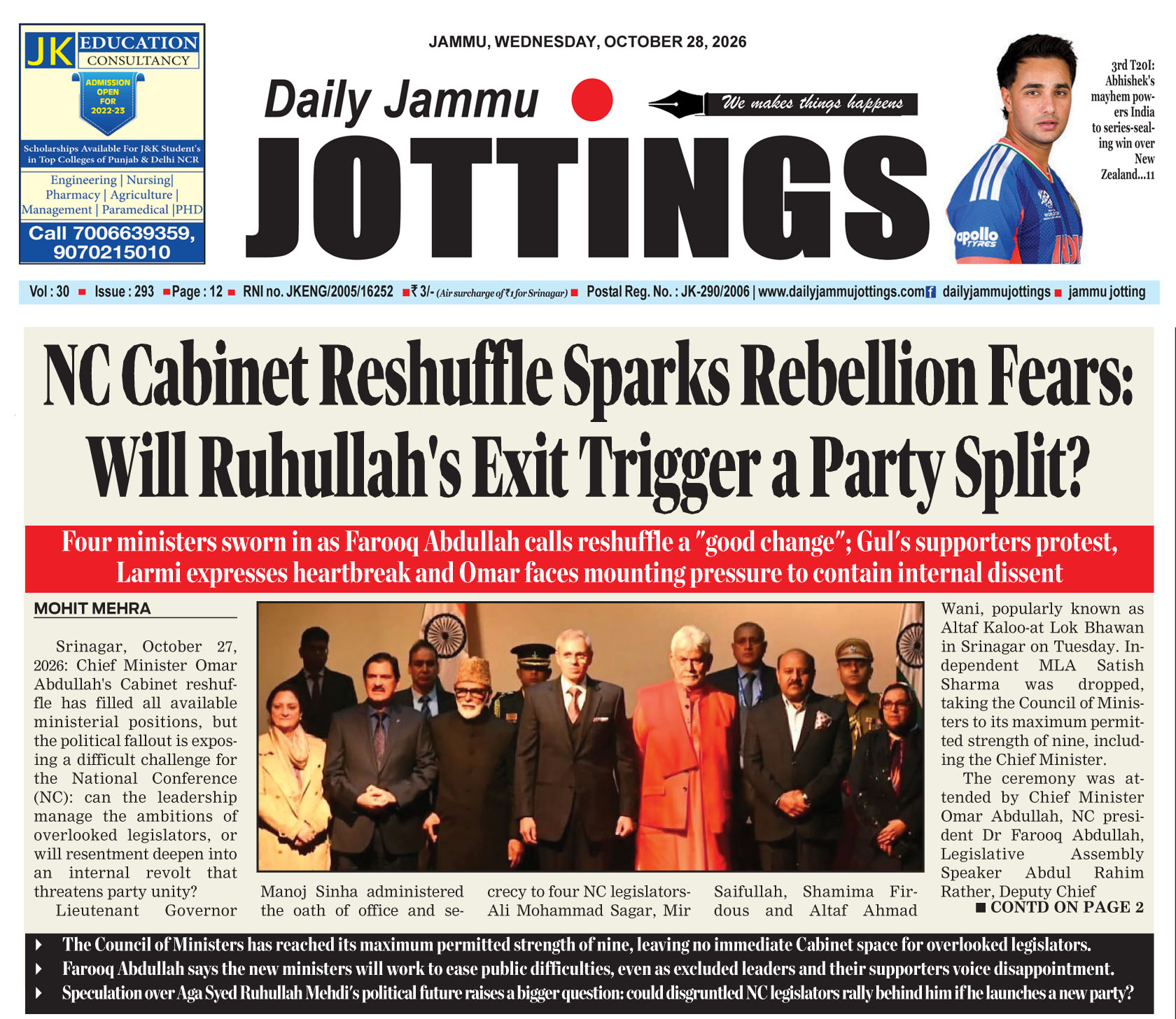
Lieutenant Governor Manoj Sinha administered the oath of office and secrecy to four NC legislators—Ali Mohammad Sagar, Mir Saifullah, Shamima Firdous and Altaf Ahmad Wani, popularly known as Altaf Kaloo—at Lok Bhawan in Srinagar on Tuesday. Independent MLA Satish Sharma was dropped, taking the Council of Ministers to its maximum permitted strength of nine, including the Chief Minister.
The ceremony was attended by Chief Minister Omar Abdullah, NC president Dr Farooq Abdullah, Legislative Assembly Speaker Abdul Rahim Rather, Deputy Chief Minister Surinder Kumar Choudhary, ministers Sakina Masood Itoo, Javed Ahmed Rana and Javid Ahmad Dar, Lok Sabha member Gurvinder Singh Oberoi, Leader of Opposition Sunil Kumar Sharma, JKPCC president Tariq Hameed Karra, CPI(M) MLA M.Y. Tarigami and PDP legislators Mir Muhammad Fayaz, Aga Muntazir Mehdi and Rafiq Naik.
Speaking at the party headquarters, Nawa-i-Subah, Farooq Abdullah welcomed the reshuffle, describing it as a “very good cabinet change”. He expressed hope that the new ministers would work to ease people’s difficulties and address public grievances. His message was one of confidence, but the immediate political mood inside the party was far less settled.
The sharpest reaction came from supporters of veteran leader Mubarak Ahmad Gul, who protested at Nawa-i-Subah after the six-time Eidgah MLA was denied a ministerial berth. They gave the leadership two days to address their demand and questioned why a leader with decades of experience had been overlooked.
Farooq Abdullah subsequently appointed Gul as the party’s general secretary, replacing Ali Mohammad Sagar, who entered the Cabinet. Gul said Farooq had given him a special assurance in a private conversation, promising to disclose details when the relevant document became available. Whether the organisational post and the assurance will calm his supporters remains uncertain.
Another senior leader, Abdul Majeed Bhat Larmi, said his “heart is broken” after being excluded, although he reaffirmed his loyalty to the party. His supporters also protested in Anantnag. These reactions reveal the personal stakes behind a reshuffle in which the number of ministerial berths is strictly limited.
The larger political question centres on Aga Syed Ruhullah Mehdi, whose differences with the NC leadership have fuelled speculation about his next move. Reports on Tuesday indicated that he was preparing to leave the party on November 3 and explore a political platform aligned with his principles. Whether he will actually establish a new party remains unclear.
Could overlooked MLAs and their supporters join Ruhullah if he launches a new formation? Could frustration turn into a coordinated revolt, or will the NC leadership manage to prevent dissent from becoming a split? No mass defection has been established, but the reshuffle has given these questions fresh urgency.
Chief Minister Omar Abdullah’s adviser Nasir Aslam Wani acknowledged that legislators had every right to feel disappointed, while explaining that the Union Territory’s limited Cabinet size made it impossible to accommodate every aspirant. The opposition, meanwhile, has urged Omar to address the grievances of those left out.
The political challenge is now bigger than selecting ministers. With every Cabinet position filled, the NC leadership must rely on organisational responsibilities, dialogue and political accommodation to keep ambitious legislators within its ranks.
Will the reshuffle strengthen Omar Abdullah’s government, or will the anger of excluded leaders create an opening for Ruhullah to build an alternative political force? The coming days will test whether the NC can contain its internal discontent before it turns into a lasting rupture.
