PoJK Erupts in Unprecedented Unrest as Massive Protests Challenge Pakistan’s Control
 admin
admin 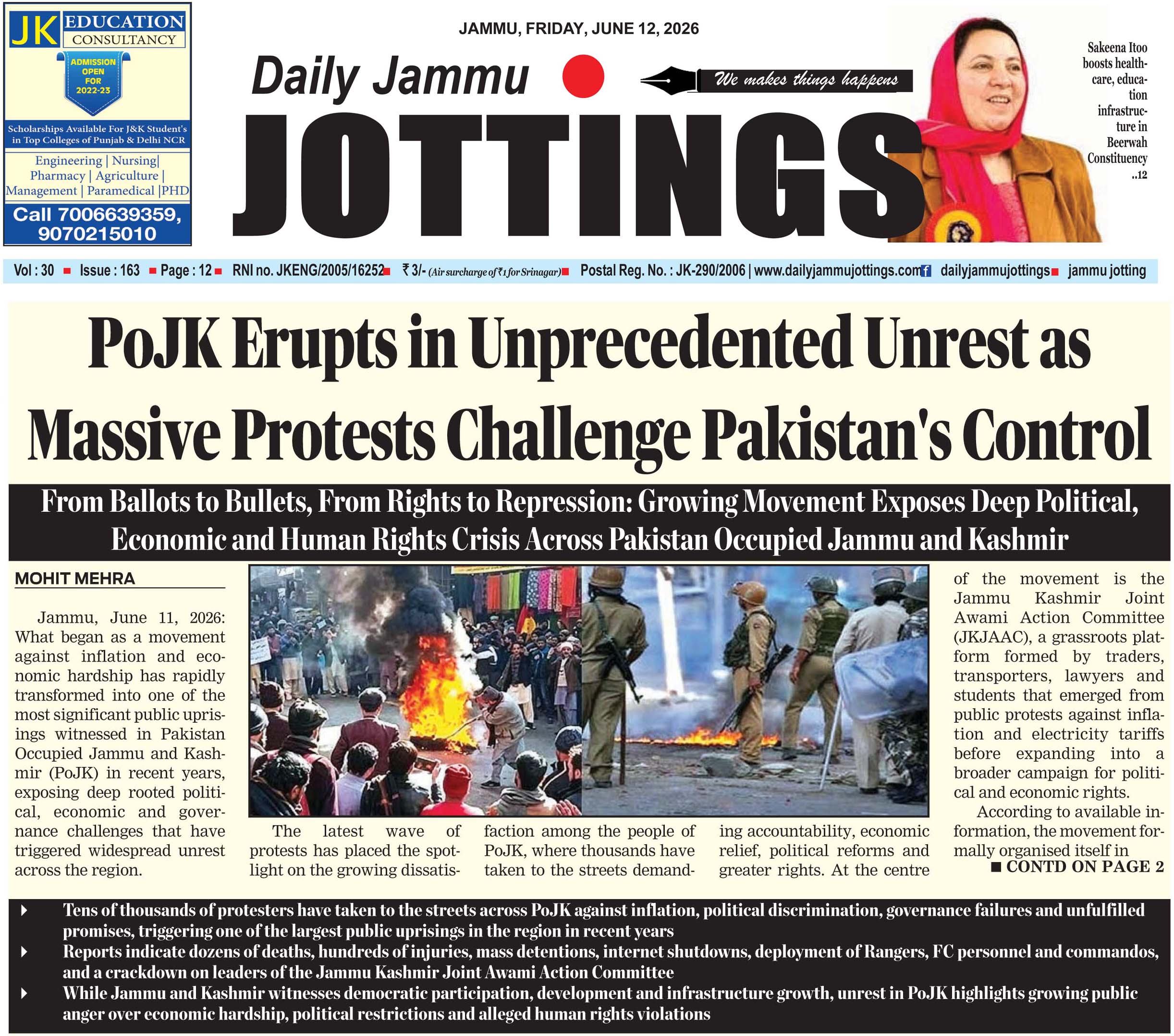
From Ballots to Bullets, From Rights to Repression: Growing Movement Exposes Deep Political, Economic and Human Rights Crisis Across Pakistan Occupied Jammu and Kashmir
- Tens of thousands of protesters have taken to the streets across PoJK against inflation, political discrimination, governance failures and unfulfilled promises, triggering one of the largest public uprisings in the region in recent years
- Reports indicate dozens of deaths, hundreds of injuries, mass detentions, internet shutdowns, deployment of Rangers, FC personnel and commandos, and a crackdown on leaders of the Jammu Kashmir Joint Awami Action Committee
- While Jammu and Kashmir witnesses democratic participation, development and infrastructure growth, unrest in PoJK highlights growing public anger over economic hardship, political restrictions and alleged human rights violations
Mohit Mehra
Jammu, June 11, 2026: What began as a movement against inflation and economic hardship has rapidly transformed into one of the most significant public uprisings witnessed in Pakistan Occupied Jammu and Kashmir (PoJK) in recent years, exposing deep rooted political, economic and governance challenges that have triggered widespread unrest across the region.
The latest wave of protests has placed the spotlight on the growing dissatisfaction among the people of PoJK, where thousands have taken to the streets demanding accountability, economic relief, political reforms and greater rights. At the centre of the movement is the Jammu Kashmir Joint Awami Action Committee (JKJAAC), a grassroots platform formed by traders, transporters, lawyers and students that emerged from public protests against inflation and electricity tariffs before expanding into a broader campaign for political and economic rights.
According to available information, the movement formally organised itself in September 2023 and later presented a 38 point charter of demands covering governance reforms, economic issues, local rights over resources, electricity tariffs and political representation. The organisation has repeatedly accused authorities of failing to honour commitments made during negotiations held in October 2025 following a six day shutdown that had paralysed large parts of PoJK.
The current agitation has emerged against the backdrop of rising prices, unemployment and economic distress. Protest leaders have criticised what they describe as excessive privileges enjoyed by ministers, legislators and senior officials while ordinary citizens struggle to afford even basic necessities such as wheat, rice and other household essentials. They have also opposed the existence of 12 Muhajir seats in the PoJK Assembly, alleging that these seats enable outside political influence over local decision making.
The scale of the unrest has been unprecedented. Reports indicate that between June 05 and June 09, clashes and protests spread across Muzaffarabad, Kotli, Mirpur, Rawalakot, Pallandri and several other areas. During this period, around 80 civilians and protesters were reportedly killed while more than 500 sustained injuries. More than 1,000 people were detained during operations launched by Pakistani security forces to contain the movement.
Several prominent leaders associated with the movement have either been injured, arrested or targeted during the ongoing crackdown. JKJAAC spokesperson and Central Committee member Umar Nazir Kashmiri was reportedly injured during clashes, while Executive Committee member Shahzaib Habib lost his life. On June 08, Tauseef Jaral, a Core Committee member from Bhimber, was arrested and lodged in jail.
Authorities responded by imposing Section 144 in Muzaffarabad and Rawalakot, sealing the central office of the Action Committee and deploying additional security forces. Reports suggest that hundreds of additional personnel, including Rangers, Frontier Corps units and Special Services Group commandos, were moved into sensitive areas. Main markets in Muzaffarabad and Rawalakot were converted into heavily guarded zones, while drones and sniper teams were reportedly deployed for surveillance and crowd control.
As tensions escalated further, internet services were suspended across PoJK until June 12 or further orders. Mobile communication services also remained disrupted in several major towns, including Rawalakot, Kotli and Muzaffarabad. Protest leaders and rights activists alleged that the communication blackout was intended to restrict the flow of information regarding developments on the ground.
The movement gained even greater momentum on June 10 when reports suggested that nearly 80,000 protesters from Mirpur, Bhimber, Sudhnoti, Bagh, Pallandri and Kotli converged on Rawalakot. Fresh clashes were reported in multiple locations, including Dheerkot and areas surrounding Kotli District Headquarters Hospital. Protesters reportedly blocked security convoys, leading to significant disruption across the region. Businesses, transport services and government offices remained shut as a widespread shutdown paralysed normal life.
The unrest has also attracted international attention. Human rights concerns have been raised following allegations of excessive force against protesters, mass arrests and restrictions on communication. The developments have intensified scrutiny of the situation in PoJK, particularly in light of demands for political participation, transparency and accountability.
Against this backdrop, observers point to the stark contrast between the political trajectories on either side of the Line of Control. While Jammu and Kashmir has witnessed regular elections, grassroots political participation, major infrastructure projects and expanding development initiatives, the unrest in PoJK has highlighted grievances relating to governance, economic opportunities and democratic representation.
Despite the crackdown, leaders of the movement have maintained that their campaign is not directed against ordinary government institutions but is aimed at securing solutions to issues affecting local residents. During a public address at Rawalakot, senior movement leaders reiterated demands for withdrawal of restrictions, release of detained protesters, restoration of normalcy and implementation of commitments previously made during negotiations.
As the crisis continues to unfold, PoJK stands at a critical juncture. The scale of the protests, the intensity of the public response and the growing international attention have transformed what began as an economic agitation into a broader movement reflecting widespread frustration over governance, political rights and economic conditions. The coming days are likely to determine whether dialogue prevails or whether the confrontation deepens further across the troubled region.