Educational Crisis Unfolds!
 admin
0 comments
admin
0 comments
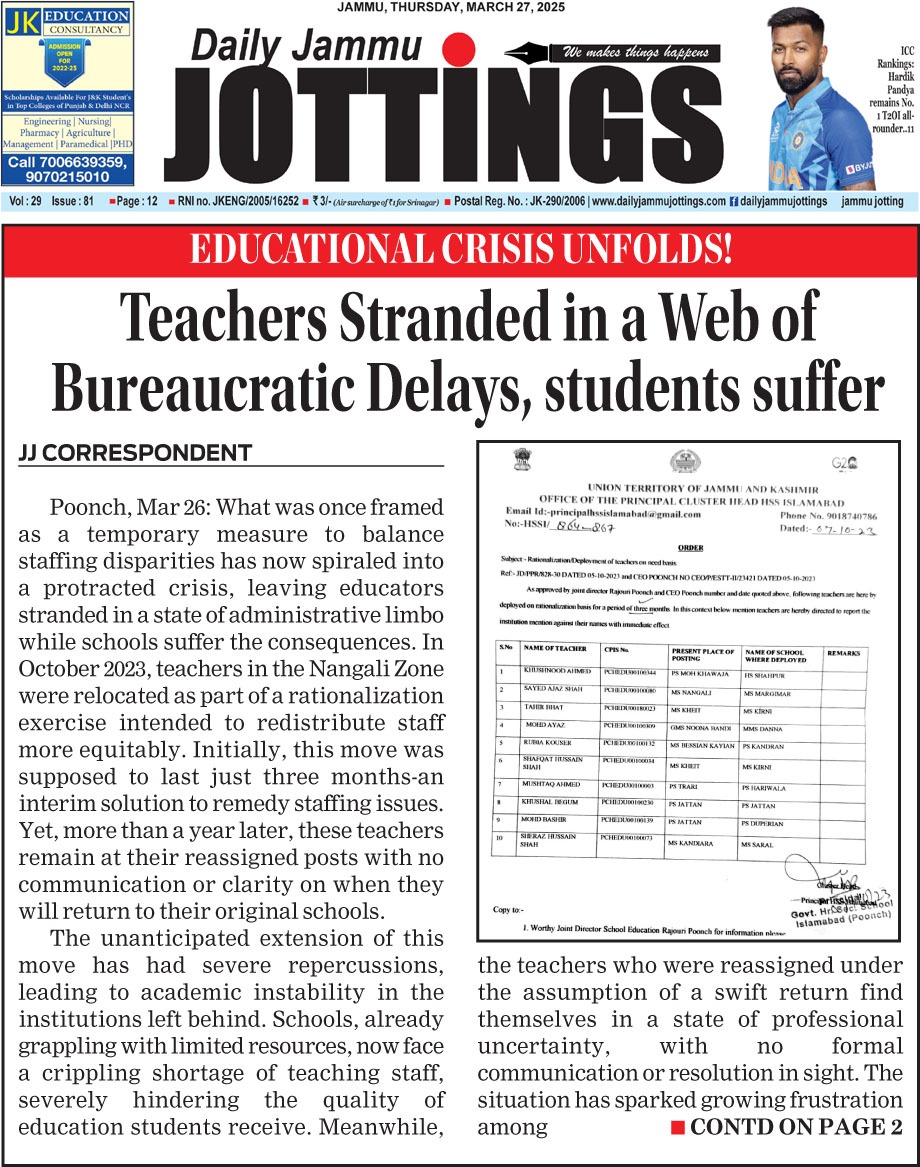
Teachers Stranded in a Web of Bureaucratic Delays, students suffer
jj correspondent
Poonch, Mar 26: What was once framed as a temporary measure to balance staffing disparities has now spiraled into a protracted crisis, leaving educators stranded in a state of administrative limbo while schools suffer the consequences. In October 2023, teachers in the Nangali Zone were relocated as part of a rationalization exercise intended to redistribute staff more equitably. Initially, this move was supposed to last just three months-an interim solution to remedy staffing issues. Yet, more than a year later, these teachers remain at their reassigned posts with no communication or clarity on when they will return to their original schools.
The unanticipated extension of this move has had severe repercussions, leading to academic instability in the institutions left behind. Schools, already grappling with limited resources, now face a crippling shortage of teaching staff, severely hindering the quality of education students receive. Meanwhile, the teachers who were reassigned under the assumption of a swift return find themselves in a state of professional uncertainty, with no formal communication or resolution in sight. The situation has sparked growing frustration among n Contd on page 2
parents and school administrators, many of whom feel abandoned by the education department. There is increasing speculation that this so-called “rationalization” could, in fact, be a covert strategy to permanently reallocate teachers without the necessary legal and procedural formalities.
The issue extends beyond the Nangali Zone and appears to be part of a broader administrative failure across district Poonch and its surrounding areas. In many cases, teachers have been moved based on informal verbal orders, bypassing official documentation and due process. Further compounding the crisis, a significant number of teachers have been reassigned to non-teaching duties in government offices, exacerbating the already dire shortage of qualified personnel in schools.
A particularly troubling issue is the lack of accountability in the biometric attendance system, which is meant to track teacher attendance and ensure salary disbursements are linked to official postings. Despite guidelines requiring biometric authentication for all teaching staff, the system is reported to be poorly implemented or entirely disregarded in many instances. This raises serious questions about how the attendance of displaced teachers is being tracked and how salaries are being processed for those who are not working at their designated posts.
Under standard procedures, a teacher’s salary is linked to their attendance at their official posting. However, with many teachers assigned to new locations without formal transfer orders, questions have arisen about how their attendance is recorded in the biometric system. Who is authorizing their salary payments despite the absence of formal documentation? Are these payments being processed through unofficial channels?
These inconsistencies undermine the integrity of the entire system and highlight the mismanagement of the rationalization process. The growing dissatisfaction among stakeholders has led education experts and social activists to demand a thorough investigation by the Directorate of School Education Jammu (DSEJ) and the Education Minister. They argue that the prolonged displacement of teachers is not only damaging the education system but also violating the very policies designed to ensure fairness and transparency in teacher assignments.
Prominent social activist Ayaz Mughal condemned the lack of oversight, stating, “This is an egregious violation of teachers’ rights and a severe disruption to students’ education. The government must immediately investigate why these teachers have not been reinstated to their original postings and take swift corrective action. If rationalization is indeed necessary, it must be executed transparently, with formal orders and clear guidelines-not through arbitrary verbal instructions that sow confusion and exploitation.”
Experts have also stressed the need for stricter enforcement of biometric attendance protocols, ensuring that teacher presence is accurately recorded in line with their official postings. They have also called for a full audit of salary disbursements to uncover any potential financial irregularities.
As the pressure builds, education stakeholders are urging authorities to prioritize transparency, fairness, and accountability in the teacher allocation process. With students’ futures on the line and the integrity of the education system at risk, calls for justice are growing louder. The pivotal question now is whether the Directorate of School Education Jammu and the Education Minister will take decisive action to resolve this crisis or continue to allow administrative neglect to undermine the education system.