Status Quo Direction in Force Since May 25; SHO Domana Asked to Implement It in Letter and Spirit, Yet Construction Linked to New BM Stone Crusher Reportedly Continues
▶️ A court directed SHO Police Station Domana on May 29 to implement its May 25 status quo order “in letter and spirit”, yet fresh GPS tagged visuals dated August 11 and 12 reportedly show construction activity at the disputed site.
▶️ The concerned Pouni Chowki Officer, instead of immediately establishing the position through the Revenue Department, initially justified the work as being on private land and later claimed that the construction had been stopped.
▶️ The biggest question now is whether the Pouni Chowki Officer failed to enforce a subsisting court order despite being informed of the alleged violation, and whether the next police report to the court will disclose the complete sequence of events.
By Mohit Mehra
Jammu, August 12, 2026: A Pouni Chowki Officer has come under serious scrutiny over the alleged failure to effectively enforce a subsisting court order after construction activity reportedly continued at a disputed site in Mandal despite a clear judicial direction to maintain status quo over an existing pathway.
The controversy concerns the civil suit Varinder Gupta Versus Badrinath and Others, pending before the Court of the 3rd Additional Munsiff, Jammu, presided over by Arvind Manhas. The case is recorded as File No. 5593/2026 with CNR No. JKM020042832026.
The court passed an interim order on May 25, 2026, directing the parties to maintain status quo with regard to the existing pathway/passage until the next date of hearing. The order followed the plaintiff’s plea that the pathway was being threatened by developments on adjoining land.
Four days later, on May 29, 2026, the issue reached the court again after an application alleged violation of the interim direction. The court recorded that the May 25 order was still in force and then issued a specific direction to SHO Police Station Domana, Jammu, to implement the order “in letter and spirit” through the police agency. A copy was sent to the SHO for compliance.
The same order made it clear that police were not authorised to use the direction to disturb possession of either party. The responsibility was to enforce the status quo order within its legal limits.
That direction places the functioning of the local police hierarchy at the centre of the controversy.
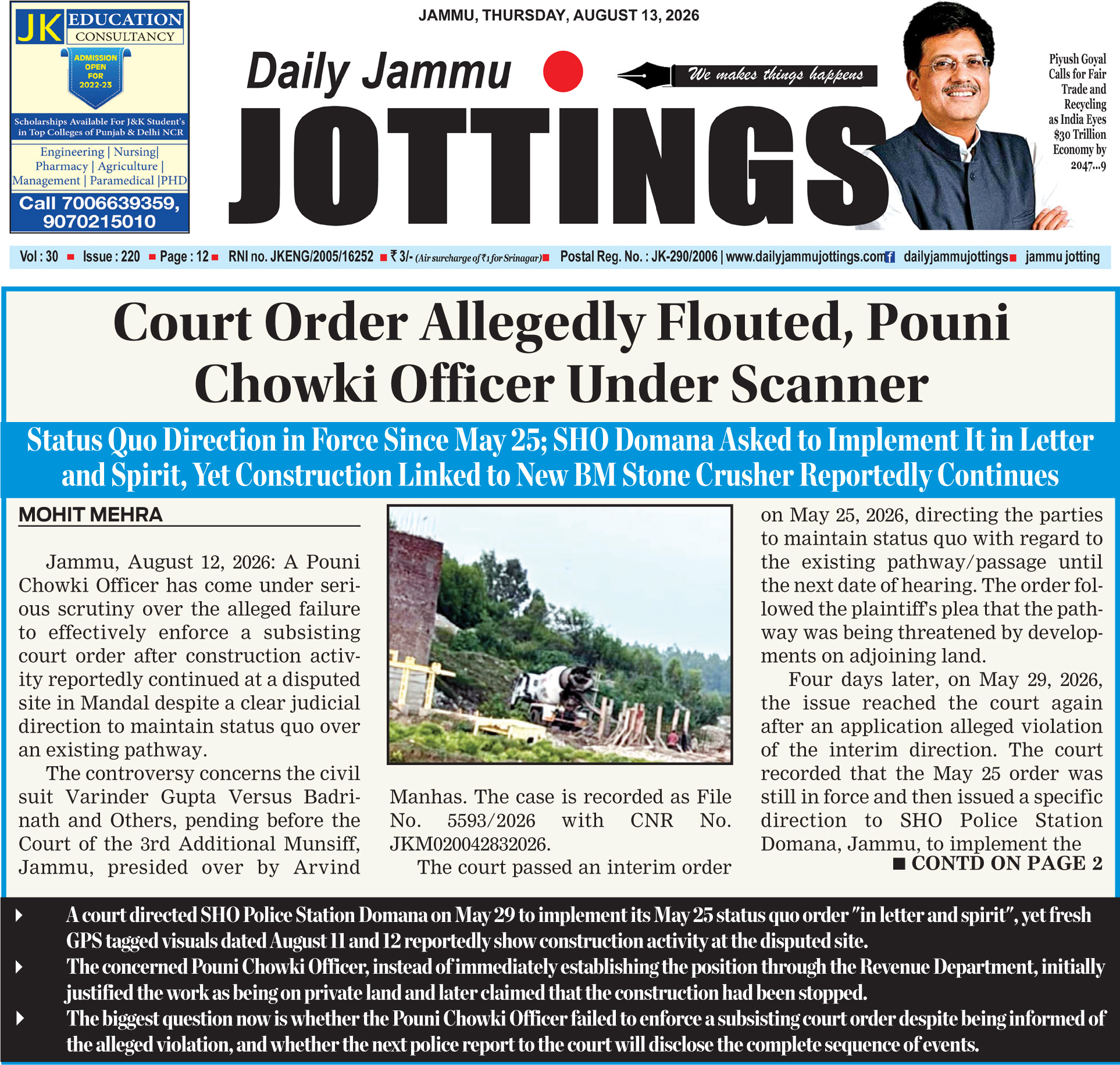
Jammu Jottings has obtained fresh GPS tagged photographs from the site showing construction related activity.
One photograph records Mandal, Jammu, at coordinates 32.711938, 74.775997, with a timestamp of August 11, 2026 at 12:29 pm. Another records coordinates 32.711835, 74.776911, again identifying Mandal, Jammu, and carries a timestamp of August 12, 2026 at 2:44 pm.
dditional video material available to Jammu Jottings also reportedly records construction activity in the area.
The timing of these visuals is significant. They have emerged more than two months after the May 25 status quo order and after the May 29 direction specifically requiring police implementation.
This raises the central question: if the SHO Domana had been formally directed to enforce the order, and the local police were aware of the disputed activity, why was construction allegedly allowed to continue?
Jammu Jottings contacted the Pouni Chowki Officer to verify the ground situation.
During the conversation, the officer initially maintained that the persons carrying out the work were working on their own land and suggested that the status quo order related to the road or pathway.
This explanation immediately raised another issue. How could the police conclusively determine whether the construction fell within or outside the protected area of the court order without first establishing the exact position of the pathway and adjoining land through official Revenue records?
Jammu Jottings specifically questioned whether the Revenue Department had been approached to verify the location, land boundaries and classification of the disputed portion.Following the questions, the Chowki Officer stated that he had stopped the work.
However, information subsequently received by Jammu Jottings from sources at the site indicated that construction activity had continued and that the work had reportedly been completed.
The two versions now require a formal and impartial verification.
If the work had genuinely been stopped, the authorities must clarify when the intervention took place, what activity was stopped and whether a written inspection or site report was prepared.
If the activity continued even after the alleged intervention, then the question becomes more serious: why was the court order not effectively enforced despite prior knowledge?
The construction activity is being linked locally to Shubam Stone Crusher.
However, the court papers presently before Jammu Jottings refer to M/s New B.N. Stone Crusher and name Badrinath, Chain Singh, Nazia Akhter and Neeraj in connection with the proceedings. The exact legal or commercial relationship, if any, between Shubam Stone Crusher and the entity named in the court case requires verification from the concerned authorities and the parties.
The plaintiff’s pleadings allege that the defendants had started development on adjoining land with the intention of establishing another stone crusher unit and that the existing passage was being obstructed or encroached upon.
The pleadings further allege that construction was being raised without mandatory statutory permissions, including consent to establish or operate and required No Objection Certificates under the Jammu and Kashmir Stone Crushers/Hot and Wet Mixing Plants Regulation Rules, 2021, issued vide S.O. 60 dated February 23, 2021. These remain allegations made in the civil proceedings and are not final findings of the court.
One of the strongest questions arising from the police officer’s response is why the status of the construction was apparently justified on the basis of a private land claim before the position was formally established through the Revenue Department.
The issue becomes more significant because information available to Jammu Jottings describes the relevant portion as “Gair Mumkin Road”.
If the official revenue record confirms such a classification, the nature of any construction at the site and the legal authority under which it was raised require examination.
At the same time, this aspect must be verified by the competent Revenue authorities rather than being decided by the police or by either side in the civil dispute.
The court proceedings themselves are focused on the existing pathway and the plaintiff’s claimed easementary rights. The court has not, in the material examined, finally adjudic of the entire disputed land.
The Pouni Chowki Officer reportedly told Jammu Jottings that a report would be submitted before the court at the next hearing, stating that the parties had violated the status quo order.
That raises an immediate question: will the police report only an alleged violation, or will it also explain what action the police themselves took after learning about the construction?
The court’s May 29 order specifically placed implementation responsibility on SHO Police Station Domana.
The next police report therefore has the potential to answer several unresolved questions, including when the police were informed, whether the site was inspected, whether the Revenue record was checked, whether construction was actually stopped and whether the activity continued thereafter.
If a violation is established, the appropriate action is a matter for the competent authorities and court in accordance with law.
The most disturbing question emerging from the episode concerns the apparent approach of the local police post.
Why did the Pouni Chowki Officer initially appear willing to accept the claim that the work was being carried out on private land instead of first verifying the position?
Why was Revenue verification not immediately sought?
Why did the officer’s position change after questions were raised?
And if the alleged construction was stopped, how did fresh GPS tagged visuals later emerge from the same area?
The questions do not by themselves establish misconduct by the officer. But they demand answers because the police officer was dealing with a dispute in which a subsisting court order had specifically been entrusted to the police for implementation.
The public interest concern is even greater because the issue involves alleged commercial construction linked to a stone crusher and a pathway whose protection has been specifically ordered by the court.
The documentary timeline is clear.
On May 25, 2026, the 3rd Additional Munsiff directed the parties to maintain status quo regarding the existing pathway or passage.
On May 29, 2026, the court recorded that the order was still in force and directed SHO Police Station Domana to implement it in letter and spirit.
On August 11 and 12, 2026, fresh GPS tagged visual material was recorded from Mandal showing construction related activity.
What happened between these three dates is now the central question.
A police officer cannot decide the civil dispute. Nor can a court order be stretched beyond its terms. But where a court expressly directs police implementation, the police are expected to act within the limits of that order and place the facts before the competent court if a violation occurs.
The next hearing and the report submitted by the police will therefore be closely watched.
The real issue is no longer simply the construction itself. It is whether a judicial direction meant to preserve the status quo has been effectively enforced, and whether the Pouni Chowki Officer and SHO Police Station Domana will provide a complete and transparent account of what happened at the site.
If the court order was violated, the violators must face the consequences in accordance with law. If it was not violated, the authorities must establish that clearly. What cannot remain unanswered is why fresh construction activity appears on the ground when a court order to maintain status quo was already in force and specifically entrusted to the police for implementation.
Leave a Reply