Jan to Apr 2026 Round-Up
 admin
admin 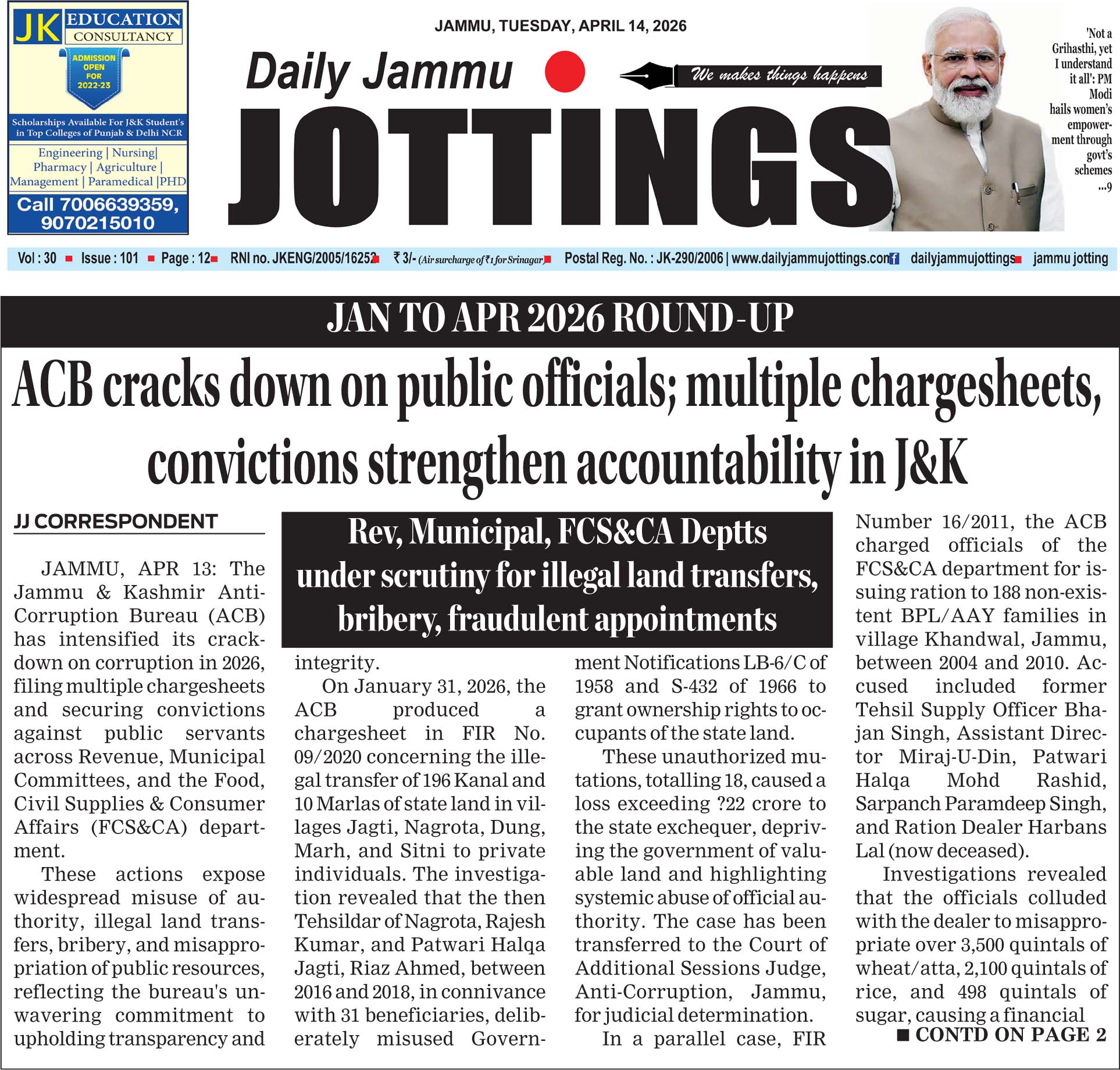
ACB cracks down on public officials; multiple chargesheets, convictions strengthen accountability in J&K
Rev, Municipal, FCS&CA Deptts under scrutiny for illegal land transfers, bribery, fraudulent appointments
JAMMU, APR 13: The Jammu & Kashmir Anti-Corruption Bureau (ACB) has intensified its crackdown on corruption in 2026, filing multiple chargesheets and securing convictions against public servants across Revenue, Municipal Committees, and the Food, Civil Supplies & Consumer Affairs (FCS&CA) department.
These actions expose widespread misuse of authority, illegal land transfers, bribery, and misappropriation of public resources, reflecting the bureau’s unwavering commitment to upholding transparency and integrity.
On January 31, 2026, the ACB produced a chargesheet in FIR No. 09/2020 concerning the illegal transfer of 196 Kanal and 10 Marlas of state land in villages Jagti, Nagrota, Dung, Marh, and Sitni to private individuals. The investigation revealed that the then Tehsildar of Nagrota, Rajesh Kumar, and Patwari Halqa Jagti, Riaz Ahmed, between 2016 and 2018, in connivance with 31 beneficiaries, deliberately misused Government Notifications LB-6/C of 1958 and S-432 of 1966 to grant ownership rights to occupants of the state land.
These unauthorized mutations, totalling 18, caused a loss exceeding ₹22 crore to the state exchequer, depriving the government of valuable land and highlighting systemic abuse of official authority. The case has been transferred to the Court of Additional Sessions Judge, Anti-Corruption, Jammu, for judicial determination.
In a parallel case, FIR Number 16/2011, the ACB charged officials of the FCS&CA department for issuing ration to 188 non-existent BPL/AAY families in village Khandwal, Jammu, between 2004 and 2010. Accused included former Tehsil Supply Officer Bhajan Singh, Assistant Director Miraj-U-Din, Patwari Halqa Mohd Rashid, Sarpanch Paramdeep Singh, and Ration Dealer Harbans Lal (now deceased).
Investigations revealed that the officials colluded with the dealer to misappropriate over 3,500 quintals of wheat/atta, 2,100 quintals of rice, and 498 quintals of sugar, causing a financial loss of approximately ₹30.33 lakh to the government. The fraudulent issuance facilitated personal gain at the expense of legitimate beneficiaries.
On February 27, 2026, the ACB filed a chargesheet against former Executive Officer MC Kupwara, Bashir Ahmad Dar, Khilafwarzi Inspector Mohammad Abdullah Malik, and the illegal landholder Ghulam Mohammad Mir, for granting unauthorized building permission and encroaching notified land intended for the Kupwara Bus Stand.
Investigations showed that Dar deliberately bypassed legal requirements, including mandatory NOC from Town Planning, issuing two permissions for a double-storey shopping complex on acquired land. This violation caused a loss of ₹57.37 lakh and jeopardized the expansion of a critical public infrastructure project, prioritizing personal interests over public welfare.
On March 12, 2026, a fourth chargesheet was filed against Abdul Rashid Shah, former Executive Officer MC Sumbal, Bandipora, for multiple corruption-related offences, including illegal/fraudulent appointments and disproportionate asset accumulation. Investigations revealed Shah purchased multiple properties, including double and triple-storey houses, plots in Sidhra Jammu, and high-value movable assets such as vehicles, electronics, and gold, exceeding his known income. Co-accused included his wife Afrooza Bano, nephew Javid Ahmad Shah, and others, who facilitated these irregularities. The case has been filed under Sections 5(1)(e) r/w 5(2) of the J&K Prevention of Corruption Act and relevant IPC provisions, with the next hearing scheduled for April 28, 2026.
In a series of landmark judgments, the ACB secured convictions against corrupt officials. On March 16, 2026, Patwari Bashir Ahmad Dar was sentenced to two years’ simple imprisonment and fined for accepting a bribe of ₹1,000 in exchange for revenue-related services. Similarly, former Tehsildar Mohd Akram Khan was sentenced to one year of imprisonment and fined ₹20,000 for demanding a bribe to influence a property dispute.
On March 31, 2026, the Anti-Corruption Court Pulwama convicted Hamida Akhter and four others for fraudulent appointments in government schools in Pulwama under FIR No. 110/1998. Convictions included imprisonment ranging from three to five years, along with fines totaling over ₹1.5 lakh, under the Prevention of Corruption Act and IPC provisions.
On April 3, 2026, the ACB presented a chargesheet against Naib Tehsildar Altaf Hussain Khan and Patwari Pardeep Kumar in Uri for demanding a bribe of ₹50,000 from a landowner seeking revenue documents. The case, filed under Sections 7 and 12 of the Prevention of Corruption Act and Section 61 of the Bharatiya Nyaya Sanhita, highlights the bureau’s continued vigilance against ongoing corruption.
On Aril 13, 2026, Special Judge Tasleem Arif of the Anti-Corruption Court Srinagar has sentenced former Patwari Ghulam Qadir Bhat to one year of imprisonment and a ₹10,000 fine for accepting a bribe in a case dating back to 2007. The conviction follows a long-standing investigation by the Anti-Corruption Bureau (formerly VOK), which established that Bhat demanded ₹3,000 to process a land mutation while posted at Halqa Khushipora Zainkot. Prosecuted under the Prevention of Corruption Act and Ranbir Penal Code by Senior Prosecuting Officer Wajahat Jameel, the verdict concludes a nineteen-year legal battle, reinforcing that public officials remain accountable for malpractice regardless of the time elapsed since the offense.
With eight major chargesheets filed and multiple convictions secured within the first four months of 2026, the ACB has sent a strong message that corruption in Jammu & Kashmir’s administrative machinery will not be tolerated. These actions reflect a sustained effort to protect public resources, promote accountability, and ensure integrity in public service.