Darbar Move Restored: CM Omar Abdullah Claims Political Victory, Revives Century-Old Tradition Despite Cost Concerns
 admin
admin 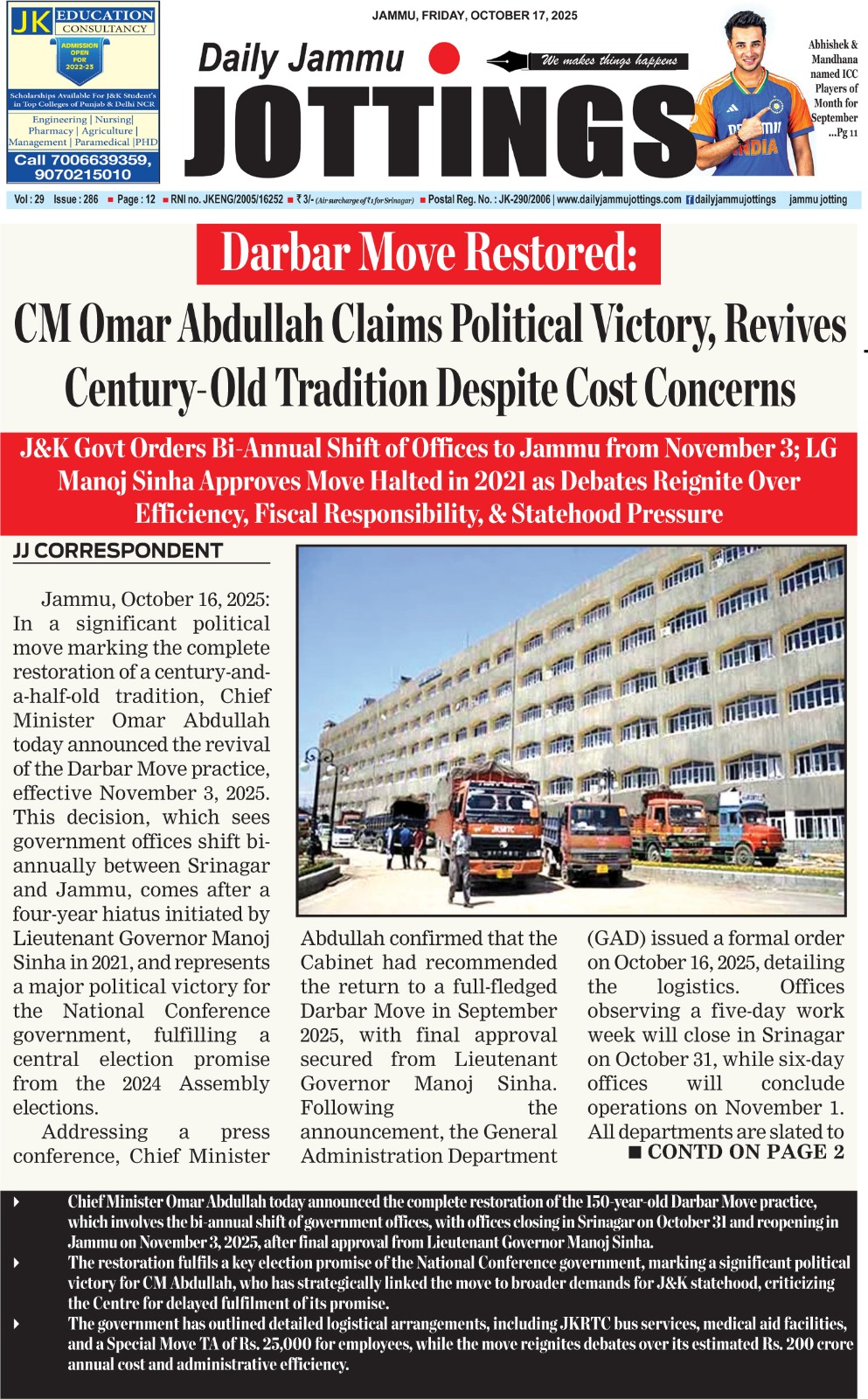
J&K Govt Orders Bi-Annual Shift of Offices to Jammu from November 3; LG Manoj Sinha Approves Move Halted in 2021 as Debates Reignite Over Efficiency, Fiscal Responsibility, & Statehood Pressure
- Chief Minister Omar Abdullah today announced the complete restoration of the 150-year-old Darbar Move practice, which involves the bi-annual shift of government offices, with offices closing in Srinagar on October 31 and reopening in Jammu on November 3, 2025, after final approval from Lieutenant Governor Manoj Sinha.
- The restoration fulfils a key election promise of the National Conference government, marking a significant political victory for CM Abdullah, who has strategically linked the move to broader demands for J&K statehood, criticizing the Centre for delayed fulfilment of its promise.
- The government has outlined detailed logistical arrangements, including JKRTC bus services, medical aid facilities, and a Special Move TA of ₹25,000 for employees, while the move reignites debates over its estimated ₹200 crore annual cost and administrative efficiency.
JJ CORRESPONDENT
Jammu, Oct 16: In a significant political move marking the complete restoration of a century-and-a-half-old tradition, Chief Minister Omar Abdullah today announced the revival of the Darbar Move practice, effective November 3, 2025. This decision, which sees government offices shift bi-annually between Srinagar and Jammu, comes after a four-year hiatus initiated by Lieutenant Governor Manoj Sinha in 2021, and represents a major political victory for the National Conference government, fulfilling a central election promise from the 2024 Assembly elections.
Addressing a press conference, Chief Minister Abdullah confirmed that the Cabinet had recommended the return to a full-fledged Darbar Move in September 2025, with final approval secured from Lieutenant Governor Manoj Sinha. Following the announcement, the General Administration Department (GAD) issued a formal order on October 16, 2025, detailing the logistics. Offices observing a five-day work week will close in Srinagar on October 31, while six-day offices will conclude operations on November 1. All departments are slated to reopen in the winter capital, Jammu, on Monday, November 3, 2025. The order specifies that offices listed in Annexure A will move “in full,” while those in Annexure B will move “in camp” with one-third of their staff or at least ten officials.
The restoration of the Darbar Move is seen as a strategic political triumph for Omar Abdullah’s National Conference, which had made its revival a central campaign promise during the first Assembly elections held since the abrogation of Article 370. The Congress-NC alliance had specifically pledged to “enhance the unity of our state by reinstating the full Darbar Move.” CM Abdullah has also leveraged this restoration to reinforce broader demands for J&K statehood, criticizing the Centre for not fulfilling its promise within his first year in office. “The solution to all of Jammu and Kashmir’s problems lies in restoring statehood,” he asserted, directly questioning the BJP’s stance on a tradition they once claimed to respect but had subsequently discontinued.
Logistical arrangements for the massive administrative shift have been meticulously detailed. The Jammu and Kashmir Road Transport Corporation (JKRTC) will provide adequate buses on November 1 and 2 for transporting employees, with advance ticketing available from October 27. Each convoy will be escorted by J&K Police, complete with cranes, empty buses, and mobile workshops, to ensure a smooth and inconvenience-free movement. The Health and Medical Education Department has been tasked with arranging medical aid facilities at strategic points, including Qazigund, Banihal, Ramsu, Ramban, Chenani, Udhampur, and Jhajjar Kotli.
Financially, employees participating in the move will receive a Special Move TA of ₹25,000. However, those who fail to move within the prescribed dates will forfeit this allowance. The salary for October will be disbursed on October 31, and advance pay may be sanctioned for non-gazetted staff to ease their transition. The order also strictly directs that no employee shall occupy government accommodation without proper allotment. The Food, Civil Supplies, and Consumer Affairs Department will ensure uninterrupted ration supply at Jammu residential colonies. During the move, the Winter Secretariat will continue to function at the Civil Secretariat in Srinagar. The Estates Department has been tasked with providing accommodation to officers and staff as per past practice. Office timings in Jammu will be 9:30 a.m. to 5:30 p.m. for the Civil Secretariat and 10:00 a.m. to 4:30 p.m. for other departments observing a six-day work week.
Initiated in 1872 by Maharaja Gulab Singh, the Darbar Move aimed to shift the capital between Jammu in winter and Srinagar in summer. While supporters argue the practice facilitates essential cross-cultural interaction between the regions, with historically around 40,000 families participating, critics highlight the substantial financial burden. The practice’s abolition in 2021 by Lieutenant Governor Manoj Sinha was aimed at saving an estimated ₹200 crore annually. The J&K High Court had also previously termed it a “wastage of resources” and an “inefficient activity.” Former leaders like Junaid Azim Mattu have criticized the revival as “archaic, unimaginative, and financially wasteful,” arguing it fosters “regional imbalance.” Conversely, the Jammu Chamber of Commerce had strongly advocated for its restoration, claiming the abolition resulted in “₹1000 crore losses” to local businesses in both regions.
The revival of the Darbar Move thus represents a significant symbolic victory for regional identity and a pragmatic political strategy by Omar Abdullah’s government to strengthen its position and exert pressure on the Centre regarding statehood restoration. However, it simultaneously reignites fundamental debates about administrative efficiency and fiscal responsibility in the Union Territory, with the economic and logistical implications under renewed scrutiny.