
‘Operation Sindoor’ Decimates Terror Camps; Pakistan Unleashes Deadly Barrage on Poonch Civilians
 admin
0 comments
admin
0 comments
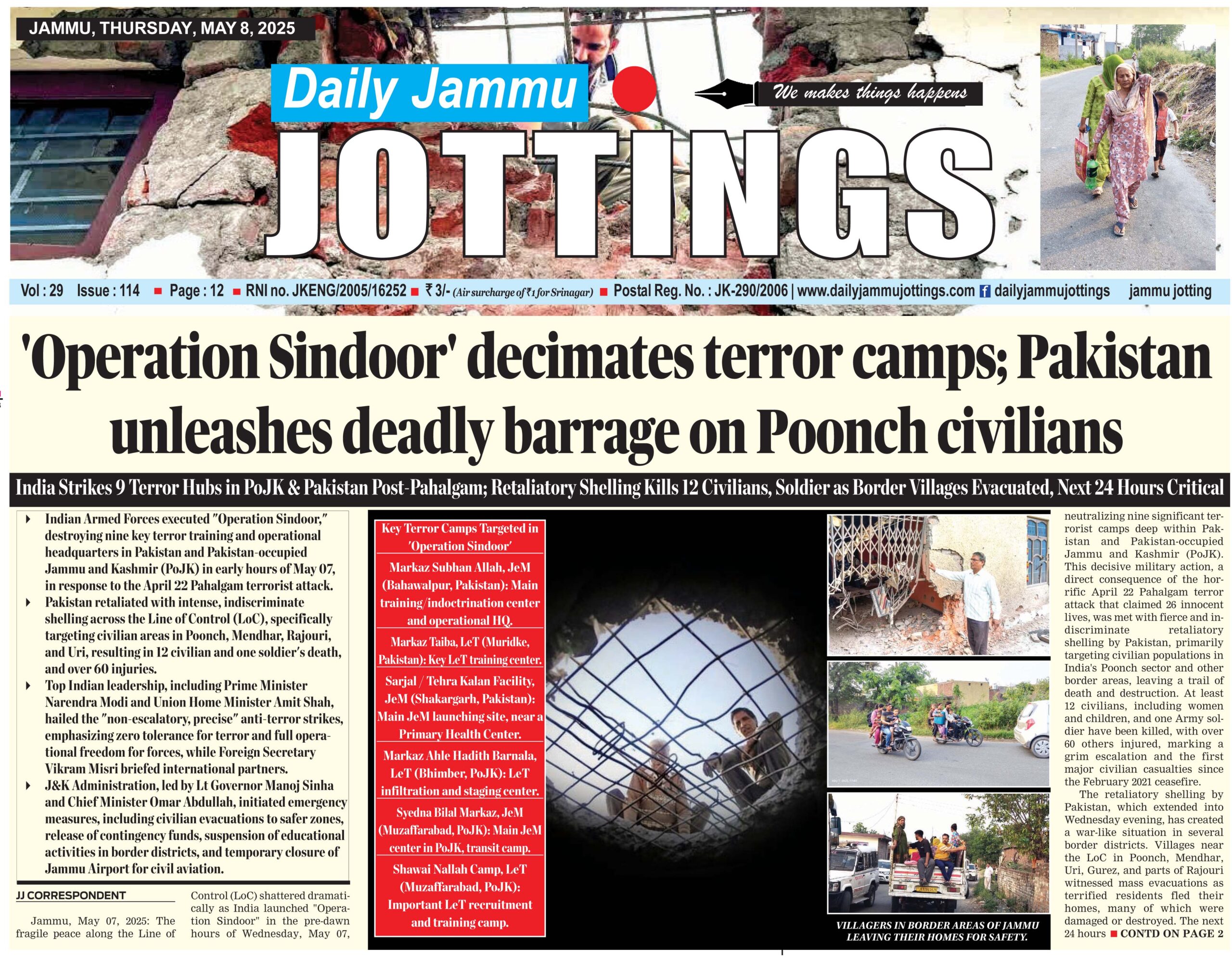
India Strikes 9 Terror Hubs in PoJK & Pakistan Post-Pahalgam; Retaliatory Shelling Kills 12 Civilians, Soldier as Border Villages Evacuated, Next 24 Hours Critical
- Indian Armed Forces executed “Operation Sindoor,” destroying nine key terror training and operational headquarters in Pakistan and Pakistan-occupied Jammu and Kashmir (PoJK) in early hours of May 07, in response to the April 22 Pahalgam terrorist attack.
- Pakistan retaliated with intense, indiscriminate shelling across the Line of Control (LoC), specifically targeting civilian areas in Poonch, Mendhar, Rajouri, and Uri, resulting in 12 civilian and one soldier’s death, and over 60 injuries.
- Top Indian leadership, including Prime Minister Narendra Modi and Union Home Minister Amit Shah, hailed the “non-escalatory, precise” anti-terror strikes, emphasizing zero tolerance for terror and full operational freedom for forces, while Foreign Secretary Vikram Misri briefed international partners.
- J&K Administration, led by Lt Governor Manoj Sinha and Chief Minister Omar Abdullah, initiated emergency measures, including civilian evacuations to safer zones, release of contingency funds, suspension of educational activities in border districts, and temporary closure of Jammu Airport for civil aviation.
Key Terror Camps Targeted in ‘Operation Sindoor’
Markaz Subhan Allah, JeM (Bahawalpur, Pakistan): Main training/indoctrination center and operational HQ.
Markaz Taiba, LeT (Muridke, Pakistan): Key LeT training center.
Sarjal / Tehra Kalan Facility, JeM (Shakargarh, Pakistan): Main JeM launching site, near a Primary Health Center.
Markaz Ahle Hadith Barnala, LeT (Bhimber, PoJK): LeT infiltration and staging center.
Syedna Bilal Markaz, JeM (Muzaffarabad, PoJK): Main JeM center in PoJK, transit camp.
Shawai Nallah Camp, LeT (Muzaffarabad, PoJK): Important LeT recruitment and training camp.
Jammu, May 07, 2025: The fragile peace along the Line of Control (LoC) shattered dramatically as India launched “Operation Sindoor” in the pre-dawn hours of Wednesday, May 07, neutralizing nine significant terrorist camps deep within Pakistan and Pakistan-occupied Jammu and Kashmir (PoJK). This decisive military action, a direct consequence of the horrific April 22 Pahalgam terror attack that claimed 26 innocent lives, was met with fierce and indiscriminate retaliatory shelling by Pakistan, primarily targeting civilian populations in India’s Poonch sector and other border areas, leaving a trail of death and destruction. At least 12 civilians, including women and children, and one Army soldier have been killed, with over 60 others injured, marking a grim escalation and the first major civilian casualties since the February 2021 ceasefire.
The retaliatory shelling by Pakistan, which extended into Wednesday evening, has created a war-like situation in several border districts. Villages near the LoC in Poonch, Mendhar, Uri, Gurez, and parts of Rajouri witnessed mass evacuations as terrified residents fled their homes, many of which were damaged or destroyed. The next 24 hours are considered crucial, as India maintains its strikes were solely against terror infrastructure, while Pakistan’s response has deliberately targeted civilian areas deep inside Indian territory.
India’s Decisive Strike: ‘Operation Sindoor’
Addressing the nation and international media, Foreign Secretary Vikram Misri confirmed that “Operation Sindoor” commenced around 1:44 AM on May 07, based on precise intelligence regarding the perpetrators and planners of the Pahalgam attack. He stated that despite a fortnight passing since the attack, there had been no “demonstrable step from Pakistan against terrorists’ infrastructure in its area.” The operation, described as “non-escalatory, precise, and responsible,” successfully neutralized all nine identified terror camps, meticulously avoiding civilian casualties and Pakistani military installations on their side. Military officials Colonel Sofiya Quresh and Wing Commander Yomika Singh reiterated the mission’s focus on justice and the utmost restraint exercised.
The targeted facilities included key operational and training centers of Jaish-e-Mohammad (JeM) in Bahawalpur and Kotli; Lashkar-e-Taiba (LeT) in Muridke, Bhimber District, and Muzaffarabad; and Hizbul Mujahideen (HM) in Sialkot and Kotli. Notably, some of these camps, like JeM’s Sarjal/Tehra Kalan facility in Shakargarh and HM’s Mehmoona Joya facility in Sialkot, were brazenly located near civilian infrastructure like a Primary Health Center and a Government Hospital respectively. The Lashkar-e-Toiba, through its proxy The Resistance Front (TRF), had claimed responsibility for the Pahalgam carnage. Foreign Secretary Misri reiterated that Pakistan continues to be a “breeding ground for terrorism,” and India has shared detailed inputs on these groups with the UN monitoring team.
Prime Minister Narendra Modi chaired a Union Cabinet meeting where Defence Minister Rajnath Singh briefed attendees on the operation. The Prime Minister reportedly reiterated his government’s zero-tolerance policy towards terror and had granted full operational freedom to the armed forces. Union Home Minister Amit Shah termed the operation “Bharat’s response to the brutal killing of our innocent brothers in Pahalgam,” while Defence Minister Rajnath Singh lauded the armed forces for their “valour and bravery,” scripting “a new history” with “precision, alertness and sensitivity.” National Security Advisor Ajit Doval briefed his counterparts in the US, UK, Saudi Arabia, Japan, Russia, China, and France, clarifying India’s “no intent to escalate but well prepared to retaliate resolutely should Pakistan decide to escalate.”
Pakistan’s Deadly Retaliation: Civilians in Crosshairs
The aftermath of “Operation Sindoor” saw Pakistan unleash a heavy artillery barrage across multiple sectors in Jammu and Kashmir. The Poonch and Mendhar sectors bore the brunt, with intense shelling also reported in Nowpora and Kalgae (Uri), Rajouri, Balakote, Mankote, Krishna Ghati, Shahpur, Laam, Manjakote, Gambhir Brahmana, and parts of Kupwara district.
The civilian toll has been horrific. Among the deceased were Ruby Kour (41), Zoya Khan (14), Zain Khan (12), Maryam Khatoon (7), and Vihaan Bhargav (13). Other victims included Mohd Akram (42), Amarjeet Singh (47), Amreek Singh (55), Ranjit Singh (48), Shakeela Bi (41), Mohd Rafi (40), Mohd Iqbal (45), and Qazi Mohammad Iqbal.
In this shelling, Lance Naik Dinesh Kumar (32), a resident of Mohammadpur village in Palwal district of Haryana, was martyred. His mortal remains will be sent to his village on May 8, where he will be cremated with full state honours.
The Indian Army confirmed it is closely monitoring the ceasefire violations and has operational freedom to respond appropriately to Pakistan’s targeting of civilians. A Defence Ministry spokesperson reiterated India’s commitment to safeguarding its citizens.
The shelling inflicted significant damage on civilian property, with many houses reduced to ashes. Four members of the Sikh community were among the killed in Poonch, and the Central Gurdwara Sri Guru Singh Sabha also suffered damage, drawing condemnation from Giani Kuldeep Singh Gargajj, officiating Jathedar of Sri Akal Takht Sahib, and Punjab Chief Minister Bhagwant Mann, who called for peace.
J&K Administration Swings into Action
The Jammu and Kashmir Administration, under Lieutenant Governor Manoj Sinha, immediately took stock of the grave situation. Deputy Commissioners in affected border districts were directed to relocate impacted populations to safer zones and ensure adequate provisions. Chief Minister Omar Abdullah chaired emergency meetings, announcing ₹5 crore in contingency funds for each border district and ordering full medical and evacuation preparedness. “We don’t want a war… Pakistan needs to silence its guns first,” Abdullah stated, later attending a meeting chaired by Union Home Minister Amit Shah to review the situation.
Poonch MLA Ajaz Jan was seen visiting affected areas and the District Hospital Poonch, assessing arrangements and leading relief efforts, including the distribution of essential supplies. The Poonch District Administration reviewed preparedness at designated shelter camps such as Caramel School, GHSS Lassana, and Polytechnic College. In a significant precautionary measure, the Office of the Divisional Commissioner, Jammu, ordered the immediate suspension of all educational activities in border districts and the temporary closure of Jammu Airport for civil aviation. Jammu Police also issued an advisory prohibiting the sharing of sensitive military-related content on social media. The situation along the LoC remains extremely tense, with authorities on high alert.