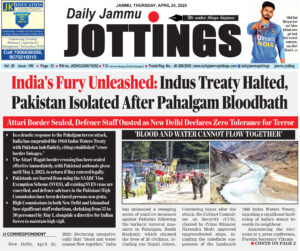
India’s Fury Unleashed: Indus Treaty Halted, Pakistan Isolated After Pahalgam Bloodbath
 admin
0 comments
admin
0 comments
Attari Border Sealed, Defence Staff Ousted as New Delhi Declares Zero Tolerance for Terror
In a drastic response to the Pahalgam terror attack, India has suspended the 1960 Indus Waters Treaty with Pakistan indefinitely, citing established “cross-border linkages.”
The Attari-Wagah border crossing has been sealed effective immediately, with Pakistani nationals given until May 1, 2025, to return if they entered legally.
Pakistanis are barred from using the SAARC Visa Exemption Scheme (SVES), all existing SVES visas are cancelled, and defence advisors in the Pakistani High Commission have been declared persona non grata.
High Commissions in both New Delhi and Islamabad face significant staff reductions, shrinking from 55 to 30 personnel by May 1, alongside a directive for Indian forces to maintain high vigil.
jj correspondent
New Delhi, April 23, 2025: Declaring unequivocally that “blood and water cannot flow together,” India has unleashed a sweeping series of punitive measures against Pakistan following the barbaric terrorist massacre in Pahalgam, South Kashmir, which claimed the lives of 26 civilians, including one Nepali citizen. Convening hours after the attack, the Cabinet Committee on Security (CCS), chaired by Prime Minister Narendra Modi, approved unprecedented steps, including the indefinite suspension of the landmark 1960 Indus Waters Treaty, signaling a significant hardening of India’s stance towards its neighbour.
Announcing the decisions at a press conference, Foreign Secretary Vikram Misri stated that the investigation into the Pahalgam attack clearly revealed “cross-border linkages,” prompting the severe response. He noted the attack occurred deliberately after the successful conduct of elections in the Union Territory. The most significant measure is the immediate suspension of the Indus Waters Treaty, a pact brokered by the World Bank that survived three previous wars (1965, 1971, 1999). This move potentially impacts the flow of the Indus, Jhelum, and Chenab rivers, vital water sources for tens of millions in Pakistan. The suspension will remain “until Pakistan credibly and irrevocably abjures its support for cross-border terrorism,” Misri declared. Under the treaty, India has full rights over the Ravi, Beas, and Sutlej rivers, while Pakistan controls the Indus, Jhelum, and Chenab.
Further isolating Pakistan, the integrated checkpost at Attari has been closed immediately. While Pakistani nationals who entered India legally via this route can return before May 1, 2025, future travel is severely curtailed. Pakistani nationals are now barred from travelling to India under the SAARC Visa Exemption Scheme (SVES), a program facilitating visa-free travel for specific categories like dignitaries, journalists, and athletes. All previously issued SVES visas to Pakistanis are cancelled, and any currently in India under this scheme must depart within 48 hours.
Diplomatic ties have also been severely impacted. The Defence, Military, Naval, and Air Advisors stationed at the Pakistani High Commission in New Delhi have been declared persona non grata, giving them one week to leave India. In a reciprocal move, India will withdraw its corresponding advisors from its High Commission in Islamabad. These specific posts in both missions are now considered annulled. Five support staff members attached to these service advisors in both High Commissions will also be withdrawn immediately. The overall strength of both High Commissions is mandated to be reduced from the current 55 personnel to just 30 by May 1, 2025.
Foreign Secretary Misri conveyed the CCS’s condemnation of the attack and condolences to the victims’ families, acknowledging the international expressions of solidarity received. The CCS also reviewed the security situation, directing all armed forces and agencies to maintain a state of high vigil. Misri reaffirmed India’s resolve, stating, “The perpetrators of the attack will be brought to justice and their sponsors held to account.” He cited the recent extradition of Tahawwur Rana as evidence of India’s relentless pursuit of those involved in terrorism.
Water Resources Minister CR Paatil endorsed the CCS decision, particularly the treaty suspension, recalling past warnings issued by Prime Minister Modi and Home Minister Amit Shah against Pakistan’s support for terrorism.
The responsibility for the Pahalgam attack was claimed by The Resistance Front (TRF), identified as an offshoot of the banned Lashkar-e-Taiba (LeT), a group long accused by India of operating with Pakistani state support. India’s drastic actions, especially the suspension of the 64-year-old water treaty – a move previously contemplated after the 2019 Pulwama attack but not implemented – underscore New Delhi’s profound frustration with what it views as Pakistan’s persistent use of terrorism as state policy. Pakistan has previously warned that interfering with the treaty could be seen as an “act of war,” raising concerns about potential escalation following India’s unprecedented measures.