Powerful Doctors, Paralyzed System & Breakdown of Governance: DH Poonch Mired in Favouritism and Neglect
 admin
0 comments
admin
0 comments
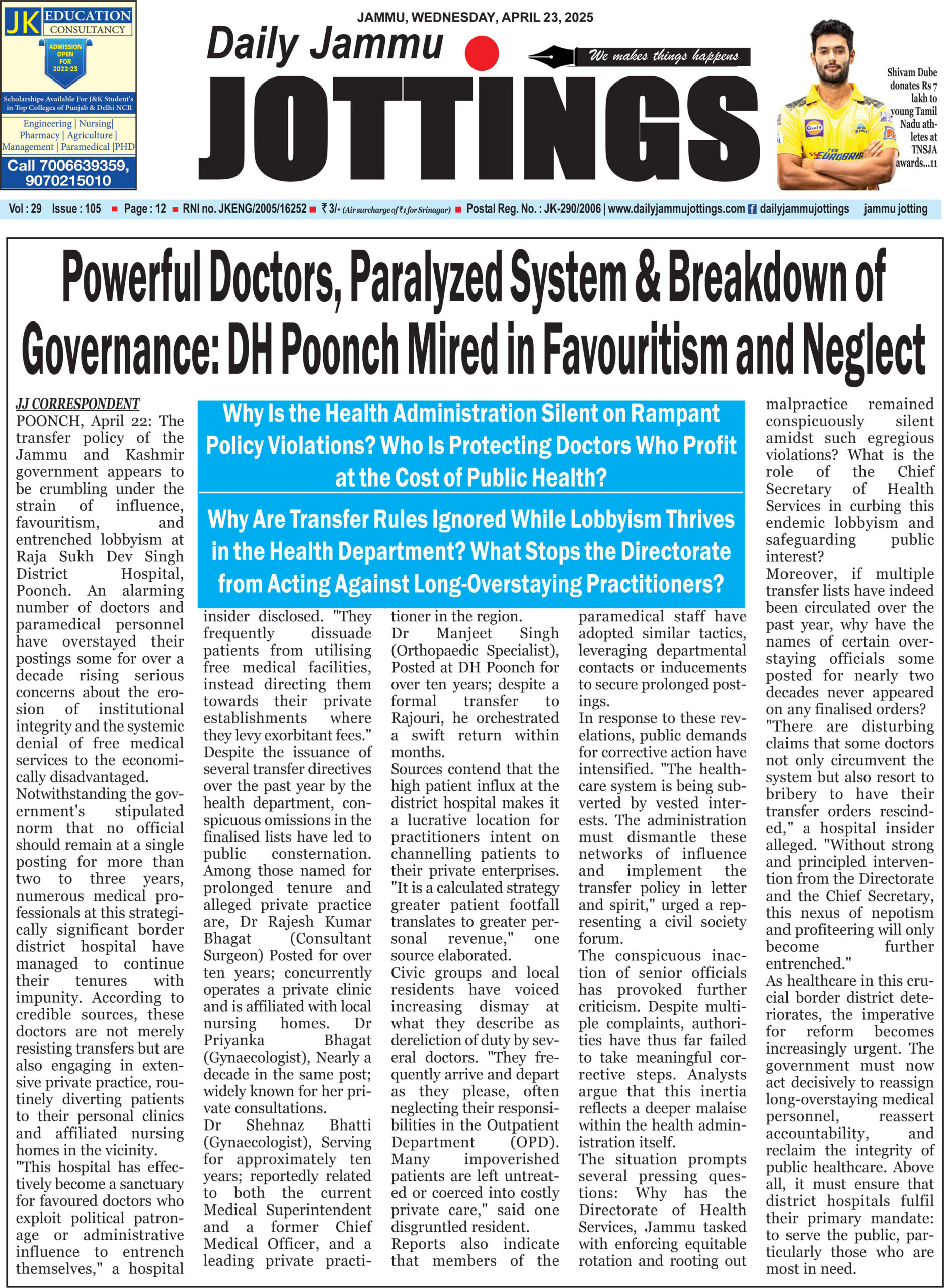
Why Is the Health Administration Silent on Rampant
Policy Violations? Who Is Protecting Doctors Who Profit at the Cost of Public Health?
Why Are Transfer Rules Ignored While Lobbyism Thrives in the Health Department? What Stops the Directorate from Acting Against Long-Overstaying Practitioners?
jj correspondent
POONCH, April 22: The transfer policy of the Jammu and Kashmir government appears to be crumbling under the strain of influence, favouritism, and entrenched lobbyism at Raja Sukh Dev Singh District Hospital, Poonch. An alarming number of doctors and paramedical personnel have overstayed their postings some for over a decade rising serious concerns about the erosion of institutional integrity and the systemic denial of free medical services to the economically disadvantaged.
Notwithstanding the government’s stipulated norm that no official should remain at a single posting for more than two to three years, numerous medical professionals at this strategically significant border district hospital have managed to continue their tenures with impunity. According to credible sources, these doctors are not merely resisting transfers but are also engaging in extensive private practice, routinely diverting patients to their personal clinics and affiliated nursing homes in the vicinity.
“This hospital has effectively become a sanctuary for favoured doctors who exploit political patronage or administrative influence to entrench themselves,” a hospital insider disclosed. “They frequently dissuade patients from utilising free medical facilities, instead directing them towards their private establishments where they levy exorbitant fees.”
Despite the issuance of several transfer directives over the past year by the health department, conspicuous omissions in the finalised lists have led to public consternation. Among those named for prolonged tenure and alleged private practice are, Dr Rajesh Kumar Bhagat (Consultant Surgeon) Posted for over ten years; concurrently operates a private clinic and is affiliated with local nursing homes. Dr Priyanka Bhagat (Gynaecologist), Nearly a decade in the same post; widely known for her private consultations.
Dr Shehnaz Bhatti (Gynaecologist), Serving for approximately ten years; reportedly related to both the current Medical Superintendent and a former Chief Medical Officer, and a leading private practitioner in the region.
Dr Manjeet Singh (Orthopaedic Specialist), Posted at DH Poonch for over ten years; despite a formal transfer to Rajouri, he orchestrated a swift return within months.
Sources contend that the high patient influx at the district hospital makes it a lucrative location for practitioners intent on channelling patients to their private enterprises. “It is a calculated strategy greater patient footfall translates to greater personal revenue,” one source elaborated.
Civic groups and local residents have voiced increasing dismay at what they describe as dereliction of duty by several doctors. “They frequently arrive and depart as they please, often neglecting their responsibilities in the Outpatient Department (OPD). Many impoverished patients are left untreated or coerced into costly private care,” said one disgruntled resident.
Reports also indicate that members of the paramedical staff have adopted similar tactics, leveraging departmental contacts or inducements to secure prolonged postings.
In response to these revelations, public demands for corrective action have intensified. “The healthcare system is being subverted by vested interests. The administration must dismantle these networks of influence and implement the transfer policy in letter and spirit,” urged a representing a civil society forum.
The conspicuous inaction of senior officials has provoked further criticism. Despite multiple complaints, authorities have thus far failed to take meaningful corrective steps. Analysts argue that this inertia reflects a deeper malaise within the health administration itself.
The situation prompts several pressing questions: Why has the Directorate of Health Services, Jammu tasked with enforcing equitable rotation and rooting out malpractice remained conspicuously silent amidst such egregious violations? What is the role of the Chief Secretary of Health Services in curbing this endemic lobbyism and safeguarding public interest?
Moreover, if multiple transfer lists have indeed been circulated over the past year, why have the names of certain overstaying officials some posted for nearly two decades never appeared on any finalised orders?
“There are disturbing claims that some doctors not only circumvent the system but also resort to bribery to have their transfer orders rescinded,” a hospital insider alleged. “Without strong and principled intervention from the Directorate and the Chief Secretary, this nexus of nepotism and profiteering will only become further entrenched.”
As healthcare in this crucial border district deteriorates, the imperative for reform becomes increasingly urgent. The government must now act decisively to reassign long-overstaying medical personnel, reassert accountability, and reclaim the integrity of public healthcare. Above all, it must ensure that district hospitals fulfil their primary mandate: to serve the public, particularly those who are most in need.