Grants passes after 3-day discussion!
 admin
admin 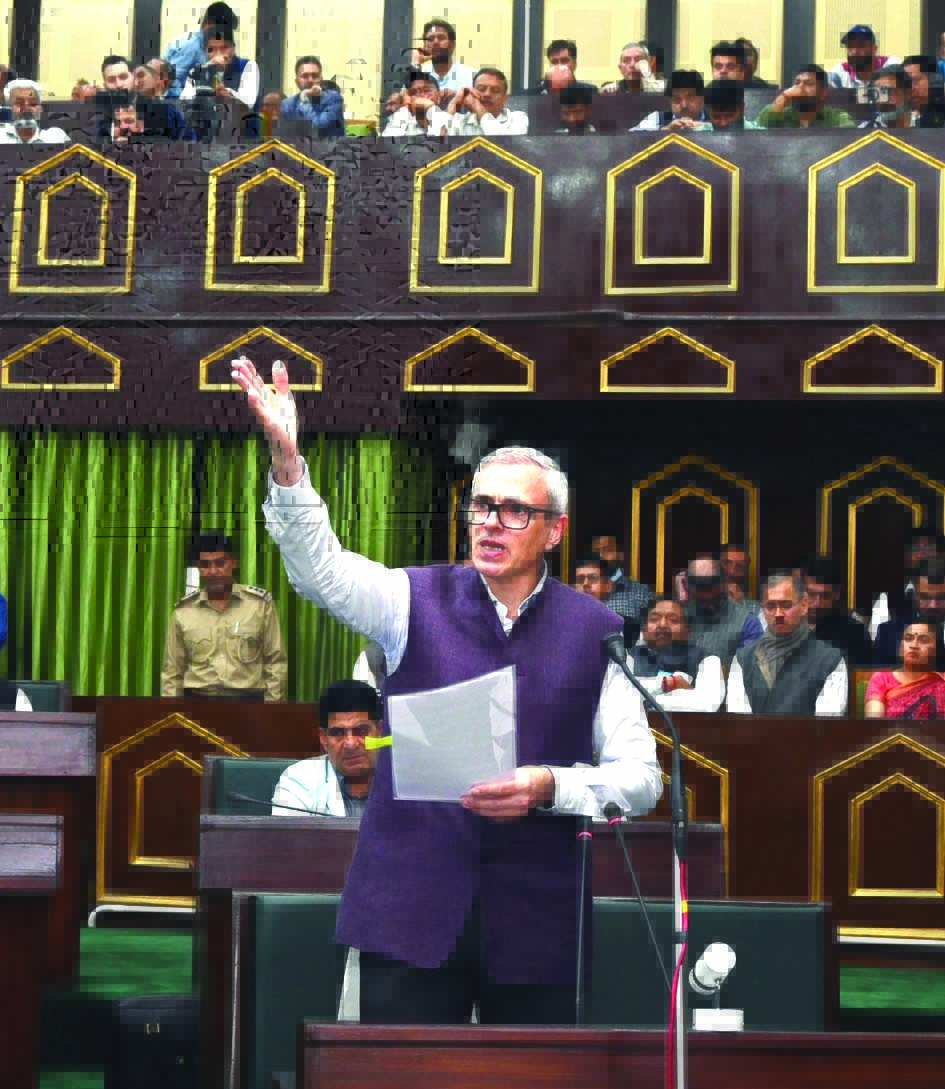
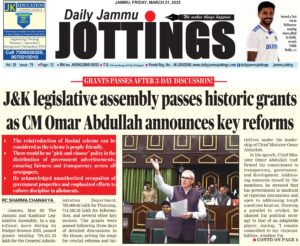
J&K legislative assembly passes historic grants as CM Omar Abdullah announces key reforms
The reintroduction of Roshni scheme can be considered as the scheme is people-friendly.
There would be no “pick-and-choose” policy in the distribution of government advertisements, ensuring fairness and transparency across all newspapers.
He acknowledged unauthorized occupation of
government properties and emphasized efforts to enforce discipline in allotments.
RC Sharma Chanakya
Jammu, Mar 20: The Jammu and Kashmir Legislative Assembly, in a significant move during its Budget Session 2025, passed grants totaling ?59,431.23 lakh for the General Administration Department, ?56,009.69 lakh for Planning, ?14,183.38 lakh for Information, and several other key sectors. The grants were passed following three days of detailed discussions in the House, setting the stage for crucial reforms and initiatives under the leadership of Chief Minister Omar Abdullah.
In his speech, Chief Minister Omar Abdullah reaffirmed his commitment to transparency, governance, and development. Addressing concerns raised by the members, he stressed that his government is unafraid of rigorous discussions and open to addressing tough questions head-on. Drawing a parallel to cricket, he likened his political strategy to that of an adaptable player, stating, “I remain committed to my responsibilities, whether I’m bowling pace or spin.”
Power Amnesty and Legislative Reforms: In a move that has been widely anticipated, CM Omar Abdullah announced a one-time power amnesty scheme for domestic consumers. However, he cautioned that while the scheme would provide relief, repeated amnesties were unfair to regular bill payers, and future schemes would encourage timely payments. Furthermore, he reiterated the importance of metering in improving revenue collection and reducing losses.
The Chief Minister also addressed ongoing concerns about legal changes in Jammu and Kashmir. He firmly stated, “We spoke of equality five years ago, and today we continue to demand it. But we must ask ourselves-are we truly equal to other states?” In response to critiques of his government’s handling of the state’s legal legacy, he clarified that the laws governing state subjects had been altered by others, not his administration.
Economic Development, Employment, and Infrastructure Expansion: The Chief Minister highlighted the pressing need for economic development and job creation for local youth. He underscored that opportunities for Jammu and Kashmir residents must be equal to those available in neighboring states. Speaking on urban development, he acknowledged challenges with the Smart City projects, such as the underutilization of footpaths and cycle tracks, and emphasized the need for a cultural shift in urban planning.
On infrastructure, he outlined plans for the development of new residential townships to decongest cities like Srinagar and Jammu, aiming to preserve the existing urban spaces from decay.
Cultural Preservation and Heritage Restoration: As part of the ongoing efforts to preserve Jammu and Kashmir’s rich cultural heritage, CM Omar Abdullah highlighted the restoration of 33 heritage sites with an investment of ?65 crore, with plans to restore 73 additional sites with an estimated cost of ?170 crore. “Heritage is our identity,” he remarked, stressing the importance of completing projects like the Mubarak Mandi restoration.
Power, Media, and Accountability Reforms: In a significant development regarding the state’s power sector, the Chief Minister announced the extension of the power amnesty scheme but insisted on reforms to ensure that such amnesties would not be a regular occurrence, thus protecting the interests of those who pay their bills on time.
Addressing concerns about media transparency, he assured the House that there would be no “pick-and-choose” policy in the distribution of government advertisements, ensuring fairness across all newspapers. He also emphasized that media outlets must function independently and critically, urging the press to highlight both the government’s successes and shortcomings.
Governance, Discipline, and Infrastructure Projects: In his address, the Chief Minister also tackled the ongoing issue of government accommodation shortages, stressing that many legislators and ministers were forced to seek private housing. He acknowledged unauthorized occupation of government properties and emphasized efforts to enforce discipline in allotments.
Additionally, he called for greater accountability in infrastructure projects, assuring the House that all new developments would adhere to Detailed Project Reports (DPRs) to avoid mismanagement and wastage of resources.
Roshini Scheme and SRO-43 Updates: On the issue of the Roshini Scheme, Omar Abdullah acknowledged the need for its reintroduction but noted that the government was unable to defend its previous form in court due to amendments made by the Ghulam Nabi Azad-led government. Regarding SRO-43, which deals with compensation for land acquired for public projects, he assured the House that all pending cases would be cleared on an urgent basis.
Concluding Remarks and Legislative Cooperation: The Chief Minister concluded his address by expressing gratitude to the legislators for their contributions during the discussions, highlighting the collective responsibility of the assembly in driving the state’s progress. He also assured the House that all concerns raised would be addressed with prompt and effective action.
In a final gesture of unity and cooperation, the cut motions on the Demands for Grants were withdrawn, signaling a productive and forward-thinking session. The Chief Minister’s speech set the tone for a future focused on balanced development, social equity, and responsible governance, laying the foundation for transformative changes in Jammu and Kashmir’s administrative landscape.
After Chief Minister’s appeal those who withdrew cut motions included Nazir Ahmed Khan Gurezi, Qaysar Jamshed Lone, Sham Lal Sharma, Nizamuddin Bhat, Tanvir Sadiq, Mian Mehar Ali, Rafiq Ahmad Naik, Payare Lal Sharma, Shakti Raj Parihar, Farooq Ahmad Shah, Dr. Shafi Ahmed Wani, Balwant Singh Mankotia, Sheikh Ahsan Ahmed (Pardesi), Salman Ali Sagar, Mubarak Gul, Ranbir Singh Pathania, Ali Mohammad Sagar, Peerzada Mohammad Sayeed, Mir Mohammad Fayaz, Satish Kumar Sharma, Sajad Gani Lone, Mir Saifullah, Javed Beigh, Irfan Hafiz Lone, Waheed ur Rehman Parra, Kuldeep Raj Dubey, Aijaz Ahmed Jan, Sajad Shaheen, Mohamad Yousuf Tarigami, Rajiv Jasrotia, Gulam Mohiddin Mir, Mushtaq Guroo, Muzaffar Iqbal Khan, Devinder Kumar Manyal, Javaid Riyaz, Shabir Ahmad Kullay, Baldev Raj Sharma, Choudhary Mohammed Akram, Hilal Akbar Lone, Saif ud Din Bhat, Dr. Narinder Singh Raina, Mehraj Malik, Darshan Kumar, Altaf Ahmed Wani, Reyaz Ahmed Khan, Iftkar Ahmed, Pawan Kumar Gupta, Sajjad Shafi, Zafar Ali Khatana, and Sunil Kumar Sharma (LoP) who took part in the discussions on the Demands for Grants.