

Lieutenant Governor Unveils Vision for Temple as “Spiritual Anchor” and “Living Emblem” of India’s Culture; SMVDSB to Empower Local SHGs, Donate 50 Shops and Motorable Track to Landowners
- Lieutenant Governor Shri Manoj Sinhalaid the foundation stone for the long-awaited Sri Shankaracharya Temple in Katra, a ₹31.51 crore project fully funded by Shri Mata Vaishno Devi Shrine Board (SMVDSB) after a six-decade wait, realizing a vision first conceived in 1967.
- LG Sinhaannounced that SMVDSB will construct 50 commercial shops within the temple complex, to be allotted to landowners who donated 41 Kanals of land for the temple, motorable track, and Yatri amenities (MoU executed in 2025), while massively boosting annual procurement from local SHGs from ₹5 crore to ₹12 crore, targeting ₹50 crore in coming years.
- The Lieutenant Governor envisions Katra carving a “unique global identity” as a vibrant spiritual hub that will generate massive economic momentum, employment, and empower youth through initiatives like Gurukul for Vedic education, embodying India’s eternal culture and collective faith, providing “lasting stability” to society.
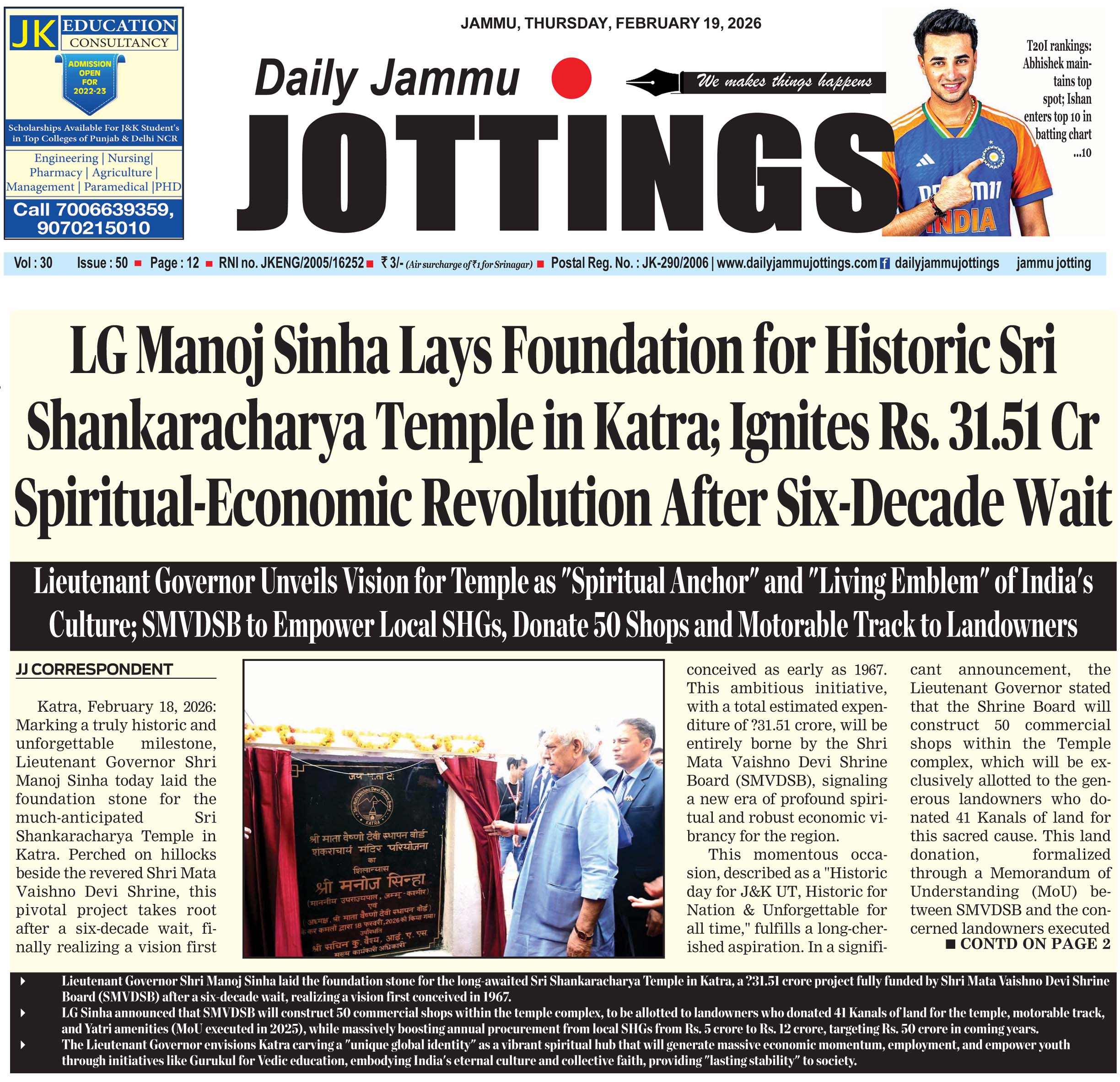
Katra, February 18, 2026: Marking a truly historic and unforgettable milestone, Lieutenant Governor Shri Manoj Sinha today laid the foundation stone for the much-anticipated Sri Shankaracharya Temple in Katra. Perched on hillocks beside the revered Shri Mata Vaishno Devi Shrine, this pivotal project takes root after a six-decade wait, finally realizing a vision first conceived as early as 1967. This ambitious initiative, with a total estimated expenditure of ₹31.51 crore, will be entirely borne by the Shri Mata Vaishno Devi Shrine Board (SMVDSB), signaling a new era of profound spiritual and robust economic vibrancy for the region.
This momentous occasion, described as a “Historic day for J&K UT, Historic for Nation & Unforgettable for all time,” fulfills a long-cherished aspiration. In a significant announcement, the Lieutenant Governor stated that the Shrine Board will construct 50 commercial shops within the Temple complex, which will be exclusively allotted to the generous landowners who donated 41 Kanals of land for this sacred cause. This land donation, formalized through a Memorandum of Understanding (MoU) between SMVDSB and the concerned landowners executed in 2025, specifically covers the creation of a motorable track and essential Yatri amenities such as toilets and water points at the Shankaracharya Ji Temple site.
LG Sinha emphasized the profound significance of the project: “In the years ahead, the Sri Shankaracharya Temple will serve as a spiritual anchor for millions of devotees. It will be a living emblem of India’s eternal culture, collective faith, resilience, and profound spiritual-cultural consciousness.” He underscored the dual impact, predicting that devotees visiting Shri Mata Vaishno Devi for darshan will also visit the Sri Shankaracharya Temple, “generating significant economic momentum across the region. This influx will create employment opportunities, strengthen local enterprises, and inject fresh energy into overall regional development.”
The Lieutenant Governor reiterated SMVDSB’s unwavering commitment to keeping spiritual hubs vibrant while prioritizing every devotee’s comfort, safety, and dignity. He observed that “when sacred sites thrive with vitality, they spark renewed faith and unlock paths to progress.” LG Sinha highlighted SMVDSB’s consistent prioritization of local community welfare, noting its generation of large-scale local employment, support for extensive business activity, and significant contribution to shaping a renewed social and cultural identity in the Union Territory.
During his visit to the holy town of Katra, LG Sinha also presided over the ‘Samridh Nari, Samridh Bharat’ program at the Spiritual Growth Centre, where he actively interacted with women entrepreneurs from Self-Help Groups (SHGs) of Reasi and adjoining areas. He announced a transformative measure approved in a recent SMVDSB meeting: the enhancement of annual procurement of Puja Samagri and Prasad from SHGs from the current ₹5 crore to ₹12 crore, significantly strengthening livelihood generation. This “standout measure” aims to onboard 20 additional SHGs into the supply chain, providing livelihood support to around 1,500 women from villages in Reasi, Udhampur, and Jammu, with total annual purchases from these groups scaled to ₹50 crore in coming years.
LG Sinha articulated a broader vision for the region: “The soul of J&K UT is deeply rooted in India’s rich civilizational heritage, so we have decided to channel Vedic education’s vast wisdom to the youth to nurture this legacy.” He said, through the Gurukul initiative, SMVDSB will nurture youth who will uphold sacred traditions and perform religious practices with authenticity and understanding. He also shared his ambitious vision for the future of the holy town: “I envision Katra carving a unique global identity in the coming years- drawing investments, superior infrastructure with Shri Mata Vaishno Devi Shrine Board support, booming business activity, and boundless opportunities for the youth.” The SMVDSB, he added, envisions building a world-class cultural and spiritual center—one that provides society with a foundation of lasting stability and will “nourish the spiritual lives of billions of devotees while simultaneously driving substantial regional economic activity.” This moment, he stressed, will “live permanently in our hearts and in the pages of history.”
The historic function was attended by Shri Suresh Kumar Sharma and Smt. Gunjan Rana, Members, Shri Mata Vaishno Devi Shrine Board; Prof. Pragati Kumar, Vice-Chancellor SMVDU; Shri Ramesh Kumar, Divisional Commissioner Jammu; Mohd Aijaz Asad, Secretary Rural Development & PR; Ms Sarah Rizvi, DIG Udhampur and Reasi Range; Shri Sachin Kumar Vaishya, CEO SMVDSB; Ms Nidhi Malik, Deputy Commissioner Reasi; along with senior officers of Police and Civil Administration, and members of women self-help groups from Reasi and adjoining districts. This foundation stone laying ceremony marks a pivotal moment, transforming Katra into a premier spiritual hub with a vibrant local economy.
