

J&K Govt Announces Free Bus Service for Women, But “Pir Panjal Left Behind Again—
The Flawed Free Bus Policy of J&K”
Toseef R Ganai
POONCH 03 April: Since 1947, the twin districts of Pir Panjal Poonch and Rajouri have endured systematic marginalization, akin to the neglect faced by an abandoned stepchild. Regardless of the political regime—be it PDP, NC, BJP, or Congress—successive governments have exhibited a perpetual apathy towards this strategically significant border region.
The deprivation spans across critical sectors, including education, healthcare, and infrastructure, leaving Pir Panjal in a state of perennial disadvantage. While the rest of the Union Territory has witnessed incremental advancements, this region has been consistently relegated to the periphery of developmental priorities.
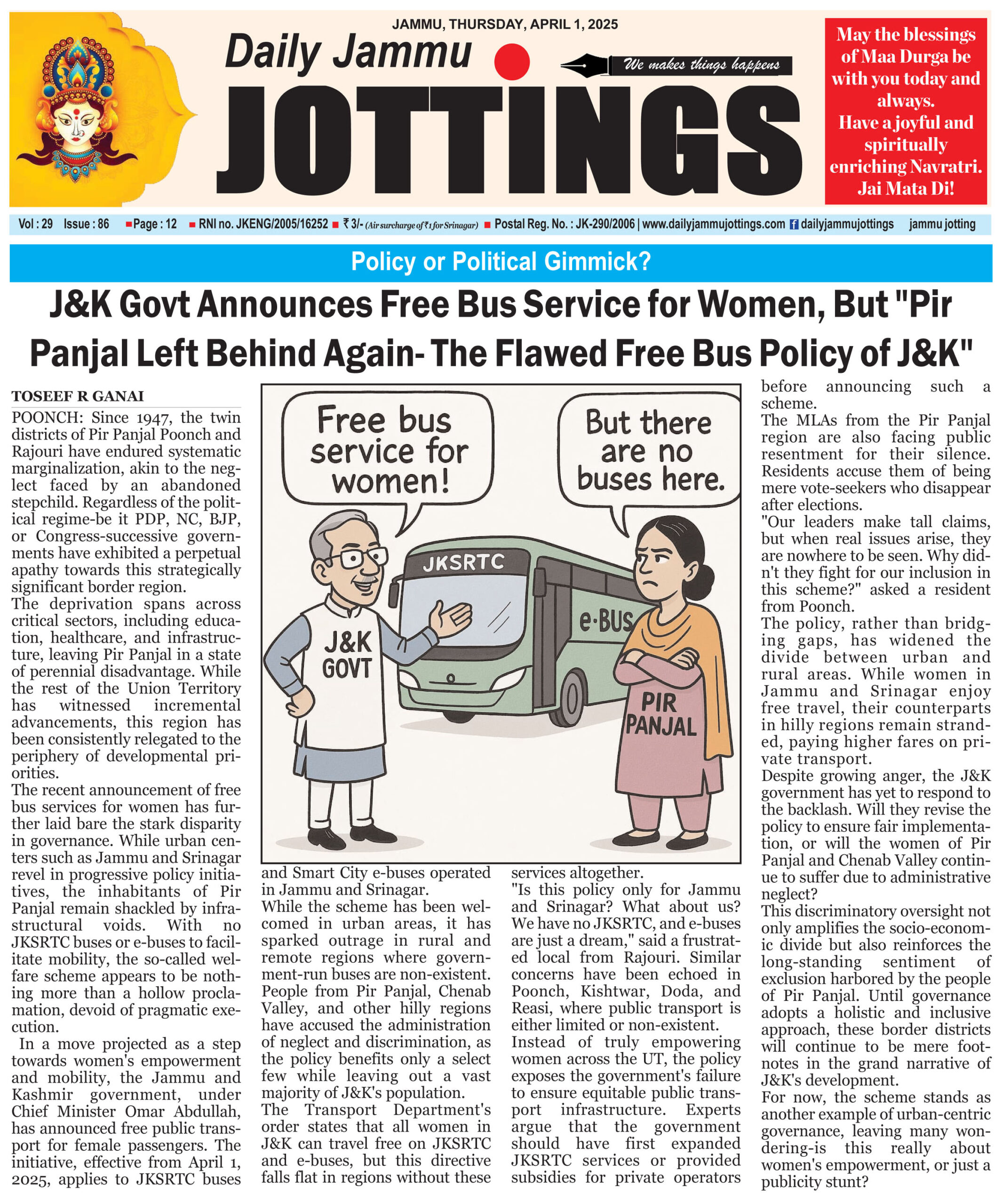
The recent announcement of free bus services for women has further laid bare the stark disparity in governance. While urban centers such as Jammu and Srinagar revel in progressive policy initiatives, the inhabitants of Pir Panjal remain shackled by infrastructural voids. With no JKSRTC buses or e-buses to facilitate mobility, the so-called welfare scheme appears to be nothing more than a hollow proclamation, devoid of pragmatic execution.
In a move projected as a step towards women’s empowerment and mobility, the Jammu and Kashmir government, under Chief Minister Omar Abdullah, has announced free public transport for female passengers. The initiative, effective from April 1, 2025, applies to JKSRTC buses and Smart City e-buses operated in Jammu and Srinagar.
While the scheme has been welcomed in urban areas, it has sparked outrage in rural and remote regions where government-run buses are non-existent. People from Pir Panjal, Chenab Valley, and other hilly regions have accused the administration of neglect and discrimination, as the policy benefits only a select few while leaving out a vast majority of J&K’s population.
The Transport Department’s order states that all women in J&K can travel free on JKSRTC and e-buses, but this directive falls flat in regions without these services altogether.
“Is this policy only for Jammu and Srinagar? What about us? We have no JKSRTC, and e-buses are just a dream,” said a frustrated local from Rajouri. Similar concerns have been echoed in Poonch, Kishtwar, Doda, and Reasi, where public transport is either limited or non-existent.
Instead of truly empowering women across the UT, the policy exposes the government’s failure to ensure equitable public transport infrastructure. Experts argue that the government should have first expanded JKSRTC services or provided subsidies for private operators before announcing such a scheme.
The MLAs from the Pir Panjal region are also facing public resentment for their silence. Residents accuse them of being mere vote-seekers who disappear after elections.
“Our leaders make tall claims, but when real issues arise, they are nowhere to be seen. Why didn’t they fight for our inclusion in this scheme?” asked a resident from Poonch.
The policy, rather than bridging gaps, has widened the divide between urban and rural areas. While women in Jammu and Srinagar enjoy free travel, their counterparts in hilly regions remain stranded, paying higher fares on private transport.
Despite growing anger, the J&K government has yet to respond to the backlash. Will they revise the policy to ensure fair implementation, or will the women of Pir Panjal and Chenab Valley continue to suffer due to administrative neglect?
This discriminatory oversight not only amplifies the socio-economic divide but also reinforces the long-standing sentiment of exclusion harbored by the people of Pir Panjal. Until governance adopts a holistic and inclusive approach, these border districts will continue to be mere footnotes in the grand narrative of J&K’s development.
For now, the scheme stands as another example of urban-centric governance, leaving many wondering—is this really about women’s empowerment, or just a publicity stunt?
