

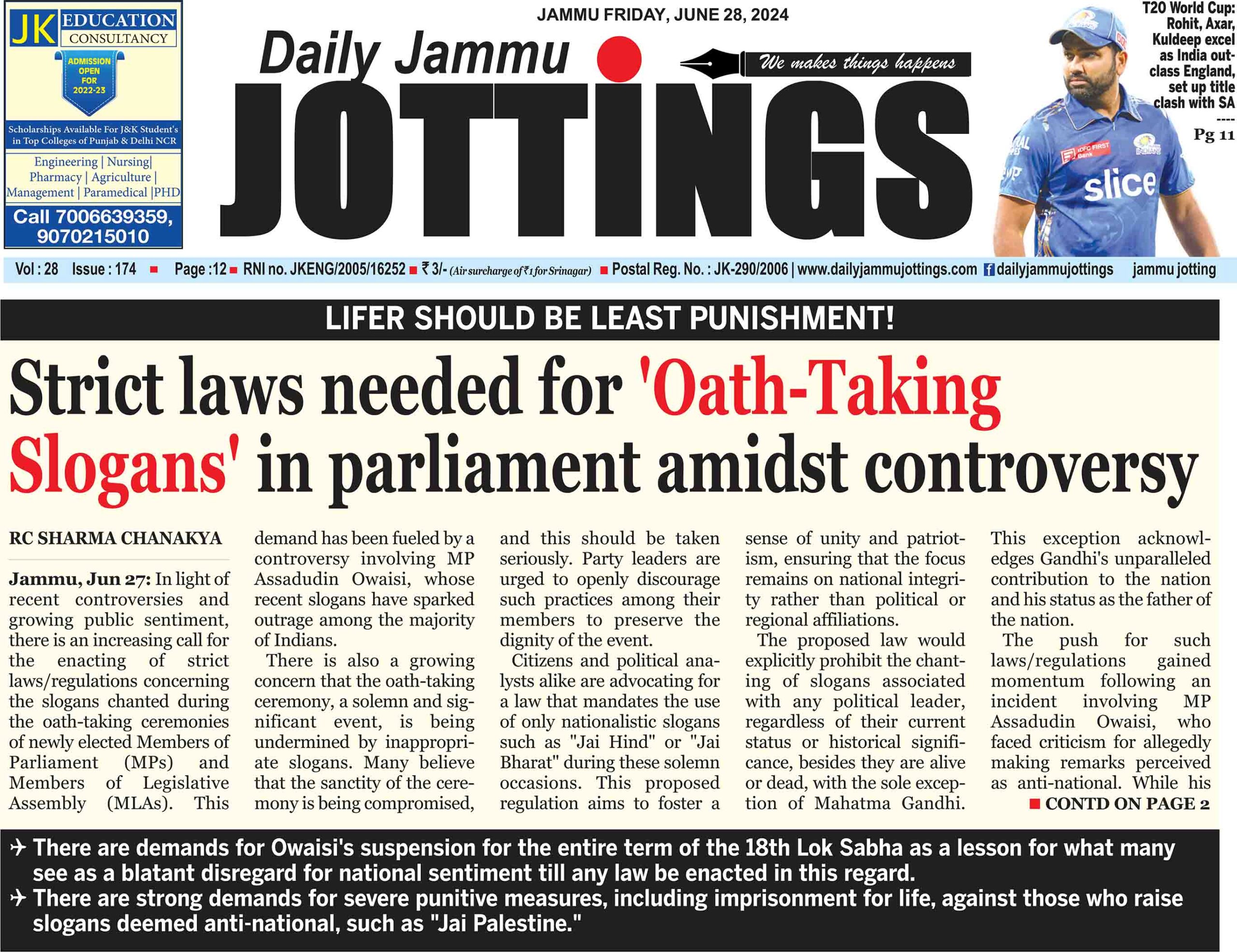
Lifer should be least punishment!
- There are demands for Owaisi’s suspension for the entire term of the 18th Lok Sabha as a lesson for what many see as a blatant disregard for national sentiment till any law be enacted in this regard.
- There are strong demands for severe punitive measures, including imprisonment for life, against those who raise slogans deemed anti-national, such as “Jai Palestine.”
RC Sharma Chanakya
Jammu, Jun 27: In light of recent controversies and growing public sentiment, there is an increasing call for the enacting of strict laws/regulations concerning the slogans chanted during the oath-taking ceremonies of newly elected Members of Parliament (MPs) and Members of Legislative Assembly (MLAs). This demand has been fueled by a controversy involving MP Assadudin Owaisi, whose recent slogans have sparked outrage among the majority of Indians.
There is also a growing concern that the oath-taking ceremony, a solemn and significant event, is being undermined by inappropriate slogans. Many believe that the sanctity of the ceremony is being compromised, and this should be taken seriously. Party leaders are urged to openly discourage such practices among their members to preserve the dignity of the event.
Citizens and political analysts alike are advocating for a law that mandates the use of only nationalistic slogans such as “Jai Hind” or “Jai Bharat” during these solemn occasions. This proposed regulation aims to foster a sense of unity and patriotism, ensuring that the focus remains on national integrity rather than political or regional affiliations.
The proposed law would explicitly prohibit the chanting of slogans associated with any political leader, regardless of their current status or historical significance, besides they are alive or dead, with the sole exception of Mahatma Gandhi. This exception acknowledges Gandhi’s unparalleled contribution to the nation and his status as the father of the nation.
The push for such laws/regulations gained momentum following an incident involving MP Assadudin Owaisi, who faced criticism for allegedly making remarks perceived as anti-national. While his remarks were expunged from the parliamentary records, many believe that this action alone is insufficient. There are strong demands for stringent punitive measures, including imprisonment for life, against those who raise slogans deemed anti-national, such as those supporting other countries like “Jai Palestine” during the oath-taking ceremony as such ceremonies are meant for only showing honest commitment to their responsibilities toward nation and people whom they are supposed to represent.
This demand has gained significant traction following an incident involving MP Assadudin Owaisi, whose slogans during his oath-taking ceremony have been criticized for allegedly hurting the sentiments of the majority of Indians. Owaisi’s chants, perceived as supportive of Palestine, have been viewed as contradictory to the Indian government’s current policy of supporting the anti-terrorism stance.
The controversy surrounding Owaisi’s remarks has ignited a passionate debate, with supporters of the proposed law arguing that it is a crucial step towards maintaining national cohesion. Detractors caution against potential restrictions on freedom of expression, emphasizing the importance of balancing national unity with democratic freedoms.
Furthermore, there are demands for Owaisi’s suspension for the entire term of the 18th Lok Sabha as a lesson for what many see as a blatant disregard for national sentiment till any law be enacted in this regard. This proposed punishment aims to deter similar behavior in the future and uphold the dignity of parliamentary proceedings.
Public outrage is particularly pronounced against MPs who are perceived to disregard national unity. There is a widespread sentiment that merely expunging offensive remarks is inadequate. Instead, severe penalties, including legal action and imprisonment, are seen as necessary to deter such actions and uphold the sanctity of parliamentary proceedings. Many believe that merely expunging Owaisi’s remarks is insufficient. Instead, there are strong demands for severe punitive measures, including imprisonment for life, against those who raise slogans deemed anti-national, such as “Jai Palestine.”
In addition, the proposed law seeks to ensure that slogans related to any specific Indian state are also prohibited during oath-taking ceremonies. This measure aims to prevent regionalism from overshadowing the broader nationalistic spirit.
As discussions on this matter continue, the call for legislative action reflects a deep-seated desire among citizens to reinforce national pride and unity during one of the most significant democratic processes-the swearing-in of their elected representatives.
The proposal is expected to be a topic of intense debate in the upcoming parliamentary sessions, with supporters arguing that it is a crucial step towards maintaining national cohesion and detractors cautioning against potential restrictions on freedom of expression.
