

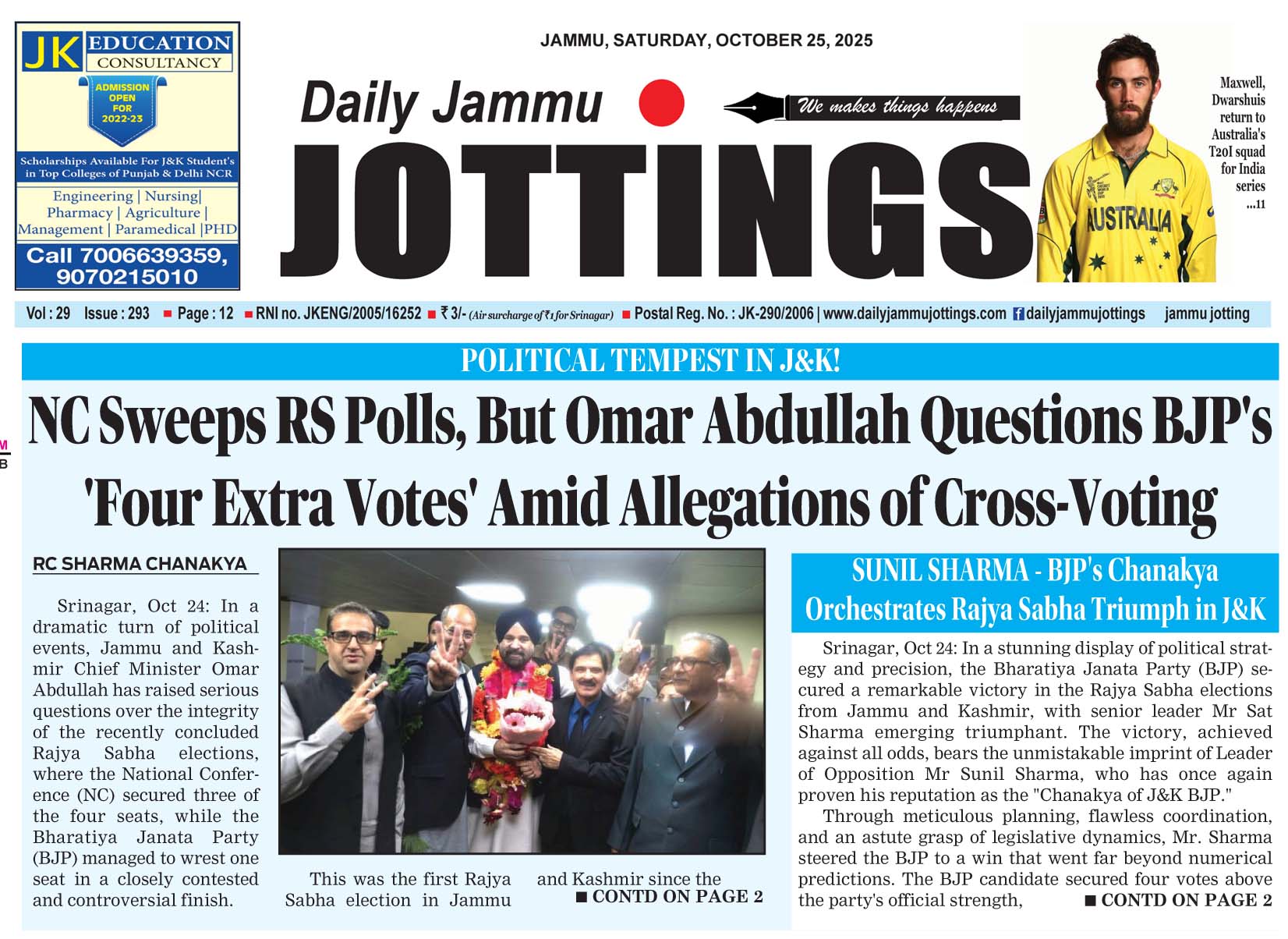
NC Sweeps RS Polls, But Omar Abdullah Questions BJP’s ‘Four Extra Votes’ Amid Allegations of Cross-Voting
RC Sharma Chanakya
Srinagar, Oct 24: In a dramatic turn of political events, Jammu and Kashmir Chief Minister Omar Abdullah has raised serious questions over the integrity of the recently concluded Rajya Sabha elections, where the National Conference (NC) secured three of the four seats, while the Bharatiya Janata Party (BJP) managed to wrest one seat in a closely contested and controversial finish.
This was the first Rajya Sabha election in Jammu and Kashmir since the abrogation of Article 370 in 2019, marking a historic yet turbulent return of parliamentary representation from the Union Territory to the Upper House.
Omar Abdullah Questions ‘Four Extra Votes’ of BJP:
Chief Minister Omar Abdullah has publicly questioned how the BJP managed to obtain four votes beyond its official strength, despite what he described as “complete cohesion” among NC legislators. Taking to social media, Abdullah alleged deliberate malpractice and moral compromise by certain MLAs.
“All of @JKNC_ votes remained intact across the four elections, as witnessed by our election agent who saw each polling slip,” Abdullah wrote. “There was no cross-voting from any of our MLAs. So the questions arise — where did the four extra votes of the BJP come from? Who were the MLAs who deliberately invalidated their votes by marking a wrong preference number? Do they have the courage to admit they helped the BJP after promising us their support? What pressure or inducement made them betray their word?”
The Chief Minister’s remarks have triggered a wave of political debate across the region, with opposition parties and independents now demanding transparency in the voting process.
NC Dominates Rajya Sabha Polls:
The NC’s Choudhary Muhammad Ramzan, Sajjad Ahmad Kichloo, and Gurwinder Singh Oberoi emerged victorious with comfortable margins, reaffirming the party’s parliamentary strength within the Assembly. However, it was the fourth seat, contested between BJP’s Sat Sharma and NC-backed independent candidate Imran Ansari that became the focal point of high-stakes political drama.
Sat Sharma secured 32 votes, four more than the BJP’s numerical strength in the House, while Ansari managed 22 votes, despite strong backing from the NC-led alliance.
The outcome, while legally valid, has politically jolted the ruling alliance. The NC leadership maintains that its voting blocs remained disciplined and unified, and has hinted that external inducements and internal sabotage tilted the balance in BJP’s favour.
Unprecedented Cross-Voting Rocks Political Circles:
According to insider reports, the BJP’s unexpected victory was facilitated by cross-voting, deliberate vote cancellations, and even an “extra” vote that mysteriously found its way into the ballot.
At least seven MLAs, belonging to either the ruling alliance or independents aligned with it, are now under scrutiny.
Sources revealed that four MLAs from the alliance voted in favour of the BJP, two votes were deliberately invalidated, and one ballot carried an intentional second preference favouring the BJP’s candidate.
NC’s second candidate, Imran Nabi Dar, who had the assured support of nearly 29 MLAs, ended up with only 21 votes — a shortfall that clearly reflected internal dissent. The party’s leadership, which claimed a total support base of 58 MLAs (including Congress, PDP, CPI-M, and independents), managed to muster only 51 votes, confirming that some of its allies defected during polling.
Polling Agents and Procedural Loopholes Under Lens:
The controversy deepened after reports emerged that no authorized polling agents were present for PDP MLAs during the voting process. Moreover, Congress MLA Nizamuddin Bhat, who was serving as his own party’s polling agent, cast his own vote without a substitute agent. When questioned, Bhat stated, “I was the chief polling agent — I showed my vote to myself.”
These irregularities have raised fresh questions about procedural oversight and the transparency of the polling mechanism in the Rajya Sabha elections.
Political Fallout and Future Implications:
The NC leadership has accused a “small but corrupt” section of legislators of betraying the alliance’s trust and selling their conscience for personal gain. Party insiders hinted that the leadership may soon push for internal investigations to identify those responsible.
Political observers believe that this incident could reshape the contours of alliance politics in Jammu and Kashmir, potentially straining ties among NC, Congress, PDP, and independent blocs.
For the BJP, however, the victory has been projected as a moral and political triumph, symbolizing the party’s growing influence in the region despite limited numerical strength.
As tempers flare and accusations mount, the Rajya Sabha elections — once expected to be a routine political exercise — have instead evolved into a full-fledged political storm, exposing deep fissures, fragile loyalties, and the relentless undercurrents of power that continue to define Jammu and Kashmir’s complex political landscape.
